Episode 10 · 2026-09-04
Good Enough for Agentic Work
Models have been sufficient for a while. What has to go is the habit of waving through work you never read.
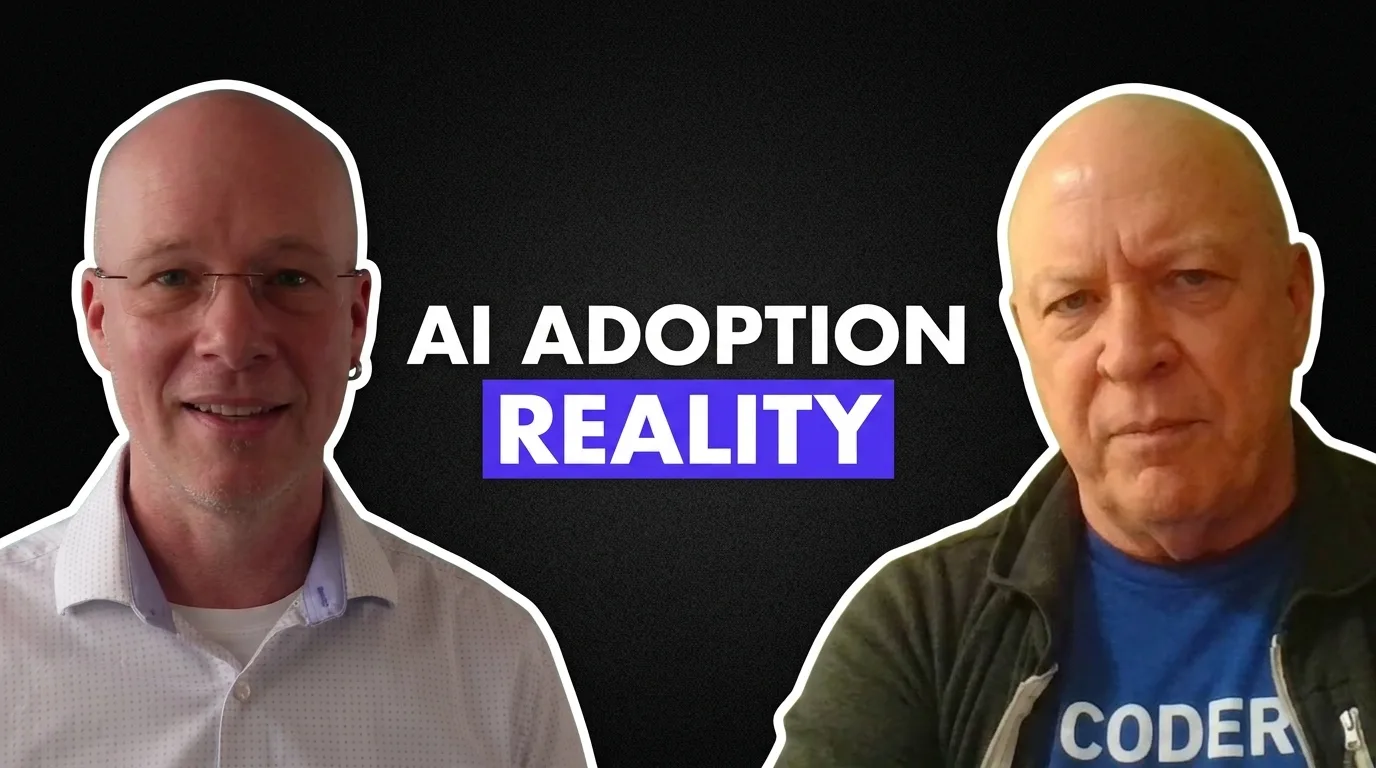
Guest Paul Gibbons spent a decade attacking change management for never proving it changed anything. Now he runs a multi-agent setup that drowns him in verification, and the habit of waving through unread work has to go.
Host Sam Rogers · guest Paul Gibbons, the change consultant · 30 min
A choice this episode can help with
How do you know an AI-adoption effort changed anything?
Run it on your own work: The Verification Budget, one page, any model.
Watch it below, or read the conversation.
Listen
Or follow the show on Apple Podcasts, Spotify, or in any podcast app.
The signals
- Paul: The plumber who left school at fifteen runs his business on AI. The speaker after Paul at a Denver talk left school, joined the military, learned plumbing, and stood up a business whose entire back end runs on AI. A firm with five thousand plumbers would have paid someone five million dollars to build that, and would never have hired him. If this lifts the bottom of the pyramid, it is a technology that changes the human race, and that is the signal Paul says inspired him.
- Sam: Buyers are settling on good-enough models and going open. Paul's hypothesis first: for any knowledge work in business the models have been more than good enough for a long time, and what matters is the harness. Sam's signal is that the revelation is landing: organizations are saying we have the one that is good enough for us and switching to an open-source model, because the data agreement on the frontier model is one many institutions cannot sign.
The subtractions
- Paul: Stop waving through work you did not read. Paul's answer from his own practice: how do you verify the work product AI generates? When he started, six pull requests waiting on GitHub got yeah, yeah, yeah, merge, merge, merge. Now he disciplines himself to read code he does not fully understand. A friend used to say "good enough for government work." Think about it hard and it is kind of disgusting, and that thinking is terrible for the age of AI.
- Sam: The model is no longer the decision. Build the stack that is good enough for the work you are doing by how you divide up the work and, more importantly, the guardrails you place around it at the harness level. That is what constrains behavior and makes it trustworthy. It is not the model, it is what goes around the model. No different than with people, which is where last week's episode ended.
About this episode
The episode opens cold on Paul drowning in his own agents: they pump out so much that he is the one who has to verify it all, and a day of his week goes to validating what they did overnight. Then it backs up into the evidence problem he has been poking at since The Science of Organizational Change: the famous study proving change management makes you 60% more likely to succeed asks people how the change management was and how successful the change was, then correlates the two. No client has ever asked him whether he had evidence for what he was saying.
Sam's own harness answers Paul's question about how to review without the reviewer producing the same bloated prose: one AI writes the spec and the test, a panel competes for the work, the winner runs it and cannot validate its own output, and a third model logs everything, all from different model families. That is Harnessie, Sam's open-source project, named on tape in the course of the conversation; nothing was paid and it is not a sponsor segment.
The back half is management. Ten years of shared context lets you say make me the deck for Friday; open a fresh session and say the same thing and you get the average of all decks. When Sam says the thing that keeps people in a predictable set of behaviors is the environment around them, Paul names it: nudge theory, the whole contribution of that school of change management. If you have ever managed anybody, you have a leg up on managing agents.
Paul would not put anyone on a change team who is not really good with AI. He knows maybe a dozen people who can talk credibly about org change and leadership and know what they are talking about with AI, and thinks that spot in the middle ought to be the most valuable coin of the realm.
Want to bring your own signal and subtraction? Find yours.
Transcript
Read the conversation
Paul: agents can pump out so much content at the end of the day, you're drowning in what we call open loops. if you got a bunch of these guys doing stuff, you're the glue that makes sure they don't get in each other's way. You're the guy that has to authorize permissions You're the guy that's got to verify it at the end. And if you've got five or ten of these things running, it's kind of like awful. I've got a day's work just to validate some of the stuff that my agents have done during the day. So it's not like easy money, I wish it was, right?
Sam Rogers: Welcome to Signals and Subtractions. I'm your host, Sam Rogers. How do you know that an AI adoption effort changed anything? Organizations often measure visible activity, right? Policies, committees, training, tool availability, but The decision requires evidence of changed behaviors or outcomes. My guest today is Paul Gibbons. He's got 30 years advising boards and C-suites on the human side of technology. At PWC, IBM, Google, Microsoft, Deloitte. He's written over 10 books. The Science of Organizational Change was one of the first to bring behavioral science. To leadership and change. And change myths went after the junk science that the change management profession is still teaching. Two things make Paul really stand out as the right guest for this show. One, he builds production AI systems himself. So he's not just describing this hypothetically from the outside. Two, as a chairman of KPMG once said to him, he never told us what we wanted to hear. He told us what we needed to hear. And Paul, that's what we love to hear. So welcome. Paul, thanks so much for being here. Really glad to have you.
Paul: Good to be here. Good to be here. And we have so much in common. It's surprising to me given that we've swum in the learning and development and org change waters for twenty years and not bumped into each other until recently.
Start here
Paul Gibbons argues that models are already good enough for most knowledge work; the hard part is the harness, evidence, and human verification around them.
Topics: AI adoption · agent supervision · verification · AI harnesses
Continue with
- Dig the Second Hole: The prior episode frames agent guardrails as architecture, the operational layer this episode calls the harness.
Put it to work
What AI initiative are you responsible for, and what evidence would convince you that it is working?
The newsletter
Issue 67 · Sunday 6 September 2026 · sent on Substack and LinkedIn.
One signal, one subtraction, one analogy, in five minutes. It draws on this episode but stands on its own. Every issue.
The method from this episode is one page with its copy-paste prompt and schema: The Verification Budget, linked under the decision above. Every takeaway.
Keep the next choice in view
One signal, one subtraction and one analogy every Sunday. Five minutes, no video required.
Optional. Free on Substack, no account needed. Already on LinkedIn? Subscribe there.