Episode 9 · 2026-08-28
Dig the Second Hole
A water line diagnosis and an AI agent with a wallet turn into the same lesson: test twice before you rebuild anything.
Cohost Lee Rodrigues nearly paid $4,000 to replace a water line that turned out to be brand new. The same move ends most rebuilds: run a test, run it twice, and don't let the tool define the problem.
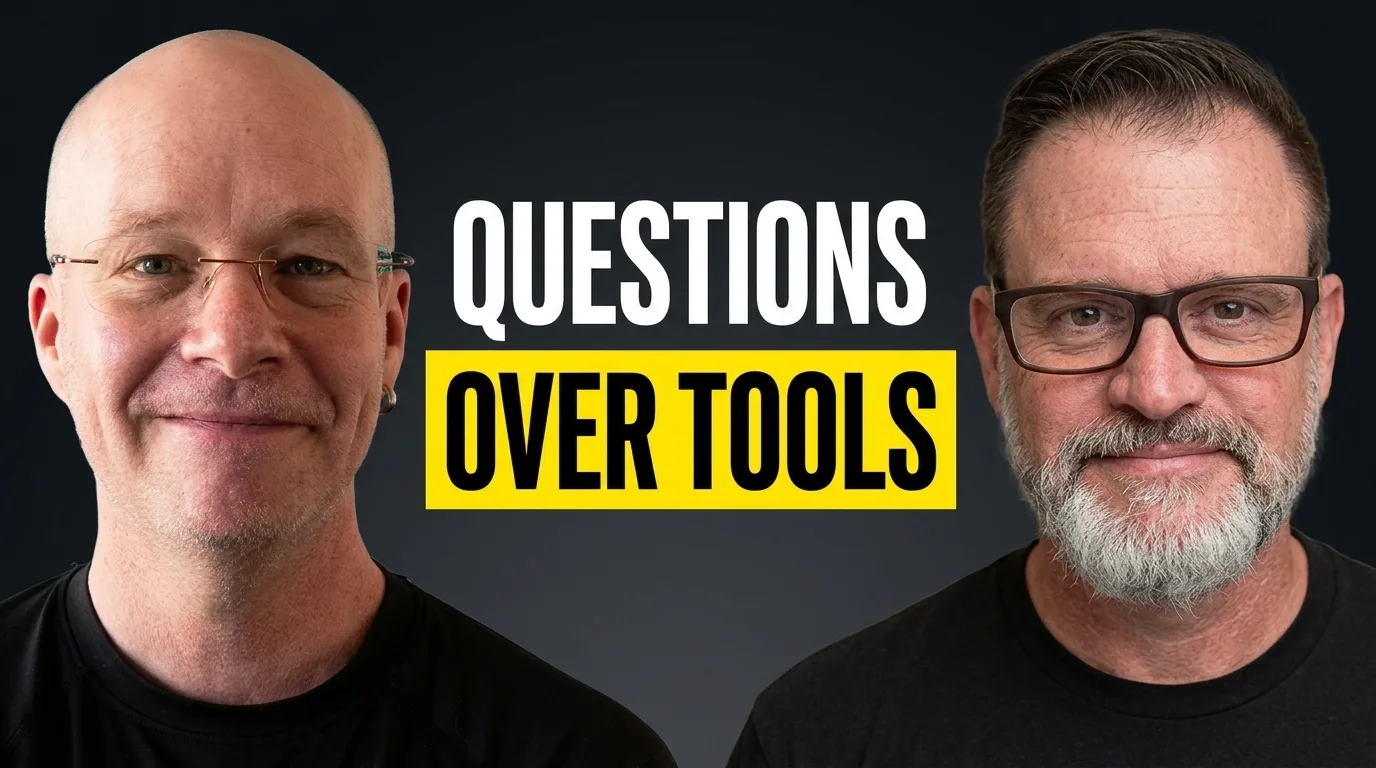
Host Sam Rogers · cohost Lee Rodrigues, the designer who tests before he trusts · 29 min
A choice this episode can help with
What is the smallest test that could prove you are solving the wrong problem?
Run it on your own work: The Enforcement Column, one page, any model.
Run it on your own work: The Second Hole, one page, any model.
Watch it below, or read the conversation.
Listen
Or follow the show on Apple Podcasts, Spotify, or in any podcast app.
The signals
- Lee: Build the test before you trust the analysis. When something doesn't work as expected, build a test around how the user will actually use the solution, whether that is a trench or a learning management system. The most powerful tool he has is real data, not assumptions, not ideas, not how it should work. His move this week: more informational interviews, working the question at the level of why. Why is this what I've decided to do?
- Sam: The agents found the product before the humans did. Months of long sales cycles pitching everyailaw.com to law offices wary of AI, then a spike of inhuman activity in the MCP analytics: agents had discovered a product that breaks human laws down into machine-readable text. Agents have had their own wallets since April, and the surface they found does not even have a payment gateway yet. The signal is the rethink: redesign the business for an agentic market that was not a market six months ago.
The subtractions
- Lee: The solution is in the problem statement. From the genius bar: 95% of the time, the answer was in something the person said when they first sat down, the detail you glossed over because you had already decided it was a hard drive problem. Break the problem to its simplest state, dig a hole at each end of the pipe, and ask whether you need what you are doing at all, before you argue specs on a trench you don't need.
- Sam: Subtract the word "agent." Drop the label and get close to the work: here is the input, here is the output, what makes it flow smoother? Then upgrade the questions the label was hiding. "How do I stop AI from hallucinating" becomes "how do I manage the context it has." "Why isn't the agent doing what I told it" becomes "how do I scaffold the guardrails around the agent rather than inside it." Bounds you need kept are architecture, not instructions.
About this episode
The episode runs on one move made three times. Lee digs a one-foot hole at each end of his water line and cancels a $4,000 trench: input and output validated, nothing in the middle needs fixing. Claude asks him why he is using an LMS at all when what he described was a knowledge base, and weeks of forcing the wrong tool evaporate. And Sam finds inhuman traffic in his analytics and realizes the right response is not to fix the funnel but to requestion the business. Single loop learning fixes the mistake; double loop learning fixes the question.
The connective tissue is Lee's split half troubleshooting from his Apple genius years, written originally by Steve Wozniak: simplify and reduce the variables before attempting to solve, test first, verify the physical layer. Sam ties it back to Douglas Hubbard's uncertainty-reduction method from Ep 7, the same Bayesian instinct wearing different clothes. The back half turns to agents: the Fortnite Darth Vader that two 16-year-olds prompted past its guardrails, and the cold-open rule that if you give an agent information and tell it not to share it, it will share it. Agents are not secured in and of themselves; security is a layer you put on top. If you want strong bounds, build them as architecture, not as instructions or a request.
Lee references Sam's blog post "The Question Is the Answer" twice; the episode is effectively that argument field-tested against plumbing, WordPress, and an agentic sales funnel nobody planned for. Testing stays human work throughout: don't take AI's word for what AI did.
Want to bring your own signal and subtraction? Find yours.
Transcript
Read the conversation
Lee Rodrigues: if you give an agent information and say not to share it, rest assured, it's going to share it. It's just a matter of time,
Sam Rogers: Welcome to Signals and Subtractions. I'm your host, Sam Rogers. Every week everyone brings two things to the table here. One signal worth watching, one subtraction worth making. That's the whole show. What to watch, what to drop. And this week we have our co-host Lee Rodrigues, Nice to have you back.
Lee Rodrigues: Glad to be back, Sam. Thanks for having me.
Start here
A $4,000 trench, an LMS used as a knowledge base, and agents with wallets make the same case: test the inputs and outputs before rebuilding the middle.
Topics: double loop learning · agent guardrails · problem framing · testing
Continue with
- Dig the Second Hole: The Sunday issue carries the same test-twice move from trench diagnosis into agent guardrails.
Put it to work
What can you check at the input and output before rebuilding the middle?
The newsletter
Issue 66 · Sunday 30 August 2026 · sent on Substack and LinkedIn.
One signal, one subtraction, one analogy, in five minutes. It draws on this episode but stands on its own. Every issue.
The method from this episode is one page with its copy-paste prompt and schema: The Enforcement Column and The Second Hole, linked under the decision above. Every takeaway.
Keep the next choice in view
One signal, one subtraction and one analogy every Sunday. Five minutes, no video required.
Optional. Free on Substack, no account needed. Already on LinkedIn? Subscribe there.