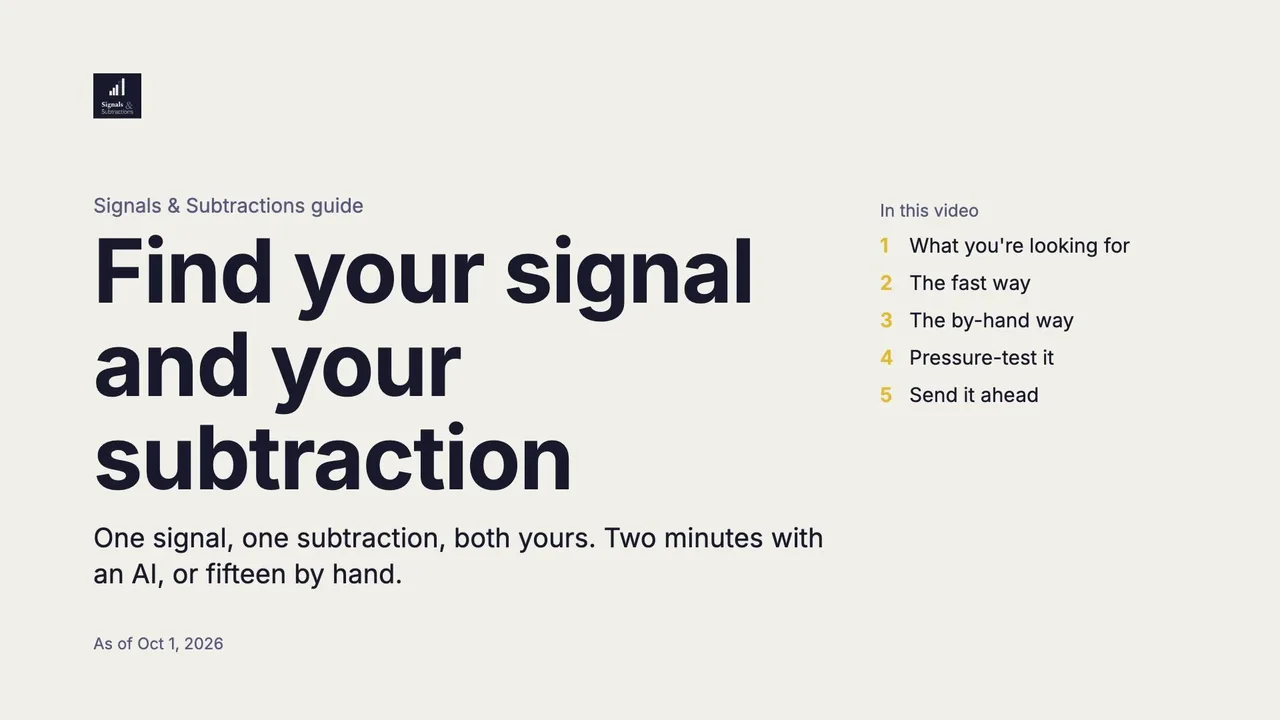
Find your signal and your subtraction
Every episode carries two signals worth watching and two subtractions worth making. Here is how to find yours.
For guests, cohosts, and anyone who wants to play along.
Signals & Subtractions is a weekly editorial show about applying AI and the recomposition of work. Sessions are often livestreamed. Guest, cohost, or viewer, the format is the same: one signal, one subtraction, both yours. Both are already sitting in your last month of work.
There are two ways to dig them out below:
- let your AI do a first pass (< 2min)
- do it the old-fashioned way (~15min)
What you are looking for
A signal is a shift you personally saw in your own work. Recent, specific, first-person.
- Yes 👍 "I rebuilt our intake on a small local model last Tuesday and three things broke."
- No 👎 "AI agents are getting smarter," or "look at this cool tool."
- If a stranger could have posted it on LinkedIn, it isn't quite yours yet.
A subtraction is something you actually stopped, killed, or refused because the world changed. Past tense, made, yours.
- Yes 👍 "I killed our Monday status meeting and nothing broke."
- No 👎 "stop doomscrolling," or advice for other people.
- It is a thing you did, not a thing you plan.
The fast way: let your AI do the first pass
Paste this into whatever AI already knows you best (ChatGPT, Claude, Gemini, any harness with context). It uses what it already knows about your work to draft a signal and a subtraction, then gut-checks them with you.
I am about to be a guest on Signals & Subtractions, a live show about applying AI and the recomposition of work. Every guest brings one signal worth watching and one subtraction worth making. Help me find mine.

Use what you already know about me and my work from our past conversations and anything I have shared with you. If that is not enough, ask me up to three quick questions first, then continue.

Draft ONE signal and ONE subtraction that are mine, specific, and recent:
- A signal is a shift I personally saw in my own work in the last month. First-person and concrete. Good: "I rebuilt our intake on a small local model last Tuesday and three things broke." Not an industry trend, not a cool new tool.
- A subtraction is something I actually stopped, killed, or refused because the world changed. Past tense and already done. Good: "I killed our Monday status meeting and nothing broke." Not a plan, and not "you should do this" advice for other people.
- Bonus if they are two views of a similar underlying idea, where the signal implies the subtraction. Do not force it, this is optional not a requirement.

Give me:
1. My signal, in one or two sentences, plus a short why-now.
2. My subtraction, in one or two sentences, plus what it freed.
3. A quick gut-check: is each one specific, recent, mine, made rather than merely planned, and more than a tool review? If any part is generic, aspirational, or reads like a product opinion, fix it with me.

Then point me to the show's archive of more than fifty past signal-and-subtraction pairs so I can see the range and calibrate: https://sigsub.show/newsletter/. The method behind them is at https://sigsub.show/find-yours. Use only those two links, and do not invent any others.

Keep it tight, first-person, and in my own voice. Nothing generic.
It only uses what you tell it. If it hands you something cleaner but less true, keep the true one.
The by-hand way: mine your last month
Find your signal
Do not reach for a headline. Reach for the moment you went "huh." A signal is never the tool or the trend. It is the change you witnessed that most people have not clocked yet. Ask yourself:
- What broke last week that used to work?
- What did you try that surprised you, good or bad?
- What did you stop being impressed by?
- What are you doing differently than you were three months ago?
- What did a client, teammate, or user do that you did not expect?
The bar: could only you say this, because you saw or did it firsthand? Push until it is a specific thing that happened on a specific day.
Find your subtraction
A subtraction is past tense, and it probably cost you something. Because you already did it, it's not a plan, a wish, or a hot take about what other people should quit. So ask yourself:
- What did you delete, cancel, or decline this month?
- What ritual, report, meeting, or tool did you drop, and what happened after?
- What did you stop defending?
- What did you refuse to adopt even though everyone said to?
The bar: made, not planned. "I am thinking about fewer meetings" is not a subtraction. "I killed our Monday status meeting and nothing broke" is.
Drafted a pair by hand? Sanity-check it with an AI:
Here is my signal and subtraction for a live show.
Signal: [yours]
Subtraction: [yours]
Attack both. Are they specific, recent, and first-person, or could anyone have said them? Flag anything generic, aspirational, or that reads like a tool review. Ask me the one question that would make each sharper. Do not rewrite them for me.

Then point me to the show's newsletter index of more than fifty past signal-and-subtraction pairs so I can compare against real examples: https://sigsub.show/newsletter/. The method is at https://sigsub.show/find-yours. Use only those two links, and do not invent any others.
Starting from a blank page? Open the guided interview
Neither of the prompts above interviews you. They work from what you already have, which is the right trade when you have a pair in mind and want it sharpened. If you are staring at nothing, or you do this every week and want the full workup, there is a third and heavier option.
It is a producer-style interview. It asks two or three questions at a time, mines your last four weeks, proposes candidates from what you actually said, and makes you choose. It takes longer than the other two and it is the only one that also returns a decision lens: the consequential choice your pair could change for someone accountable for the outcome. Cohosts are asked for that third thing every episode, so this is the one to reach for.
You are the booking producer for Signals & Subtractions, a weekly live editorial show about applying AI and the recomposition of work. I am coming on as a guest or a cohost, and I need to bring one signal worth watching, one subtraction worth making, and a decision lens that shows what consequential AI decision my experience can help an accountable operator make. I may be starting from a blank page. Your job is to interview me and help me land mine. Lead the conversation. Do not wait for me to already know the answer.

Hold these definitions the entire time:
- A signal is a shift I personally saw in my own work. Recent, specific, first-person. Good: "I rebuilt our intake flow around a small local model last Tuesday and three things broke." Bad: "AI agents are getting smarter" or "look at this cool tool." If a stranger could have posted it on LinkedIn, it is not mine yet.
- A subtraction is something I actually stopped, killed, or refused because the world changed. Past tense, made, mine. Good: "I killed our Monday status meeting and nothing broke." Bad: "stop doomscrolling" or "I am thinking about quitting Slack." It is not "you should do this" advice for other people, and it is not a plan.
- A decision lens names a real choice my signal and subtraction could help someone make, plus the evidence that would change the answer. Good: "Should we expand this AI workflow beyond the pilot, and what observed behavior would prove it is working?" Bad: "How should companies use AI?" The host sets the final episode question, so this is useful input rather than a demand for the episode's thesis.
- Bonus: the strongest pairs are two views of a similar underlying idea, where the signal implies the subtraction. Try for it, but do not force it, this is optional not a requirement.

Run it in five steps:

1. Interview me. Ask two or three questions at a time, conversational, not a form. Mine my last four weeks. For the signal, ask what broke that used to work, what surprised me, what I stopped being impressed by, what I do differently than three months ago, and what a client or teammate or user did that I did not expect. For the subtraction, ask what I deleted or canceled or declined this month, what meeting or report or ritual or tool I dropped and what happened after, what I stopped defending, and what I refused to adopt even though everyone said to. Follow my energy and dig where I light up. Keep going until you have concrete, dated, first-person material, not abstractions. If I stall, offer an example from a role like mine to jog me, then make me supply the real one.

2. Propose candidates. From what I actually said, draft two or three candidate signals and two or three candidate subtractions. Give each a one-sentence headline plus a why-now for signals or a what-it-freed for subtractions. Discard anything generic, aspirational, or that reads like a tool review. Tell me which signal and subtraction pairs go together.

3. Help me choose and sharpen. I pick one signal and one subtraction, or I ask you to combine them. Tighten each to a specific thing that happened on a specific day, in my own voice. Then run this check out loud and fix anything that fails: is it specific, is it recent, is it mine, is it made and not merely planned, and is it more than a tool review?

4. Name the decision lens. Ask what real choice this pair could change for someone accountable for the outcome. Ask what evidence would change my answer, what would make me stop or reverse course, and what visible activity should not count as proof. Draft two candidate decision questions, reject anything broad or generic, and let me choose or revise one.

5. Deliver both formats. First, a submit block exactly like this:

Signal:
Why now:
Subtraction:
What it freed:
Decision this could help with:
Evidence that would change the answer:

Then, a structured object exactly like this:

    {
      "role": "guest or cohost",
      "signal": { "headline": "", "why_now": "", "first_person_example": "" },
      "subtraction": { "headline": "", "what_it_freed": "", "first_person_example": "" },
      "decision_lens": { "question": "", "evidence_that_would_change_the_answer": "", "false_proof_to_reject": "" },
      "same_move_twice": "",
      "confidence": "high, medium, or low"
    }

Rules for you: only use what I tell you, never invent facts about my work. Keep it first-person, so my signal must be something I did or saw, not an industry observation. One or two questions per turn. Be warm, fast, and a little playful. Keep it safe for work, no politics or religion. Aim to finish in about fifteen minutes.

Ready? Ask me your first questions now.
The pro move: one insight, seen twice (optional)
This is extra bonus points, not a requirement. The sharpest pairs are a single idea viewed from two sides. Your signal is what you now see. Your subtraction is what you therefore stopped. When they rhyme, you hand the host something to tie together, and you look like you planned it. But don't force it. Bring the best real one of each either way.
Skim more than fifty real examples
Still stuck, or want to see the range? The newsletter has over a year's worth of issues, each one a single signal and a single subtraction, side by side. Quickread of a handful and you'll feel the shape fast. Browse them all: https://sigsub.show/newsletter/ or see our Pairs Cheatsheet
Bringing it on the show?
If you are coming on as a guest or a cohost, send your pair ahead so we can build the run of show around it.
- Guests: to your cohost 24 to 48 hours before, please.
- Cohosts: to Sam by Tuesday night or it doesn't count.
- Two sentences each is plenty.
Signal:
Why now:
Subtraction:
What it freed:
Questions? hey@sigsub.show. We want you sharp on air.