The newsletter · Sunday 4 October 2026
Carved in Stone
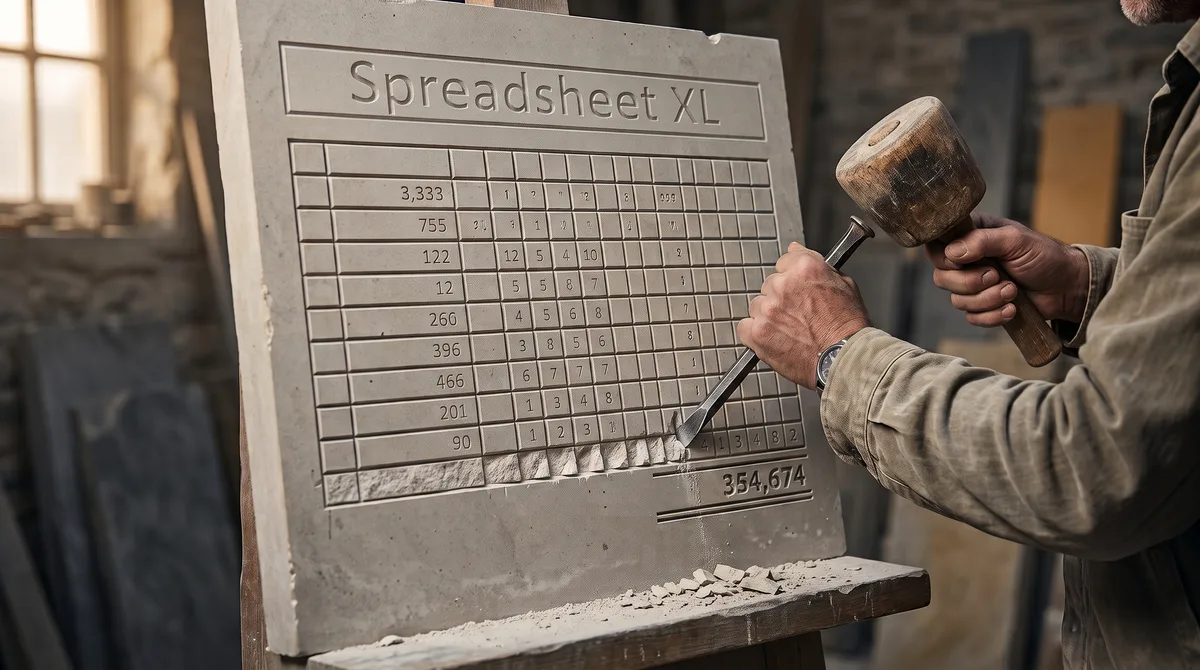
Most AI work arrives like a spreadsheet pasted as values. Temporarily correct at best.
One signal 📡 One subtraction ➖ One analogy 📊
Created by Sam Rogers of Snap Synapse | Episode 14 with guest Limited Edition Jonathan | The Sunday newsletter of the weekly show | originally published at sigsub.show
The test this week. Pick one thing an AI made for you this month. Ask for one small change. Count what else moved.
📊 Analogy of the Week: Values Only
On the show I tried to explain something with the analogy of vector versus raster graphics. My guest, Limited Edition Jonathan, was kind about it: "Sure, this might help like...four people understand." True. So for the rest of you, let's try a spreadsheet instead.
You inherit the budget in MS Excel. The total says $4,212,500. You click the cell, and the formula bar shows... $4,212,500. Just the number and a dreaded sinking feeling.
Somebody tidied the sheet before sending it and chose Paste Special, Values Only. Every number is still correct. Then finance asks what happens if we hire two more people, and there's nothing to change. Nothing on the sheet knows where anything else came from, so that one question means reworking the whole entire thing to rebuild your way to a dynamic and useful answer.
Most AI work arrives like that sheet. Jonathan put it plainly: ask a chatbot for a small fix, "and then everything about it changes." It isn't being careless. It never had the formulas, only the values it produced last time, so the only way it can change one thing is to make everything up again. Inevitably differently.
The sheet and the AI output look identical the day they arrive. The difference only shows up at the second request.
A finished answer with no formulas behind it is a photo of the work, not the work.
📡 Signal: The formula is now the hard part
A real estate company had 20 years of files, 1.2 million of them. No person was ever going to read them, so no one knew which were duplicates, which were stale, or which actually mattered.
Jonathan started by throwing the biggest frontier models at the pile, and soon learned "That was dumb." So he started sharpening the axe, deciding what to ask every document. Duplicate or not? Stale or not? Which county? How many people? Worth a closer look or not? Hours invested here, then setting it up only took minutes. Then "1.2 million documents were processed in under five minutes," and only the 40,000 that earned a closer look went on to a full language model.
Look at where the effort went. Minutes to run, hours to write the questions. Those questions are the formula. They don't care whether the pile is 1.2 million files or next year's 200,000, and when the business wants a new question answered, that's one more line, not a new project.
The work that used to be expensive was doing it. The work that's expensive now is writing it down so it can run again.
▶️ Watch, read, or listen
Watch the full episode on YouTube, or find every format including the transcript at sigsub.show/episodes/ep-014. Also on Substack and LinkedIn.
Jump to a segment: a few hours on the questions · everything about it changes · four people · always version
➖ Subtraction: Stop overwriting the working file
Jonathan's agents can make anything they like. What they can't do is unmake it, or anything else for that matter. "I want a new version. I don't want to overwrite the old version." And for the humans: "When it comes to working files, you should always version. Period." If the storage fills up, his answer is to buy more storage.
That might sound like it argues with our previous issue & essay Permanent = Expired, where I said to throw out stale knowledge without even opening it. But they're actually fully compatible. What expires is the values: the deck, the report, the answer that was right in April. What we keep is the formulas, every version of them, because that's the only place the next answer can come from. Toss the output. Don't overwrite the source.
So run the one-change test on something you rely on. Ask for one small change. If one thing moves, you have formulas. If everything moves, you have values, and you're keeping a photo of the work while the work itself is gone.
Values expire. Formulas get versioned.
🧭 Put It to Work
The night before the livestream I made four 2-minute video guides for sigsub.show with Jonathan's open-source LEJ AI Video Guides kit. It builds into a real editor with layers and separate pieces, so when an intro ran long, the fix was a text edit and a regeneration, not a new voiceover. That's composability: the finished thing stays made of parts we can change one at a time.
Handoffs are where most organizations paste as values. Each specialist passes along the finished file, and the reasons stay behind with whoever made it. The Handoff Check, this episode's takeaway, gives each handoff a row: what it protects, whether one person with one capable model could now run the whole chain, and who would check it if they did. Every episode has at least one takeaway now, fifteen so far at sigsub.show/takeaways.
Then the choice this episode can help with. Which handoff in your organization exists only because the work used to need a team, and what is it actually protecting now? Or start smaller: Name one handoff in your org that one person with a capable model could now run end to end. Who would check it? Send me your answer, or bring it to the show.
Next time someone sends a finished file, check for the formula not just the value.
Good luck,
Sam Rogers Keeper of the Formulas

New here? Subscribe at sigsub.show and the next episode lands in your inbox.
This week's guest: Limited Edition Jonathan. His Session Board is the manager session from the episode, ready to use. If you're geek enough.
Next week's episode leans the other way. My guest is Michelle Florendo, whose work is not in AI but in Decision Engineering.
Related reading:
- Permanent = Expired (051): all knowledge has a shelf life, so toss it by the date. This issue adds the other half: the outputs spoil, the formulas get versioned.
- Align to the Spec, Not to the Prompt (008): a versioned spec outlasts endless prompt tweaks. A spec is a formula for behavior.
Get the next one
Free weekly newsletter on Substack. No account needed.
One signal, one subtraction, one analogy, every Sunday. Every issue, back to 001.