The newsletter · Sunday 2 August 2026
Guilty Until Proven Human
The writer is not notified. The appeal, if you want one, arrives after the label already exists.
One signal 🔭 One subtraction ➖ One analogy 🍎
Created by Sam Rogers, building PAICE.work | Episode 5 with guest Limited Edition Jonathan | The Sunday newsletter of the weekly show at sigsub.show
🔭 Signal: The Bias We Built On Purpose
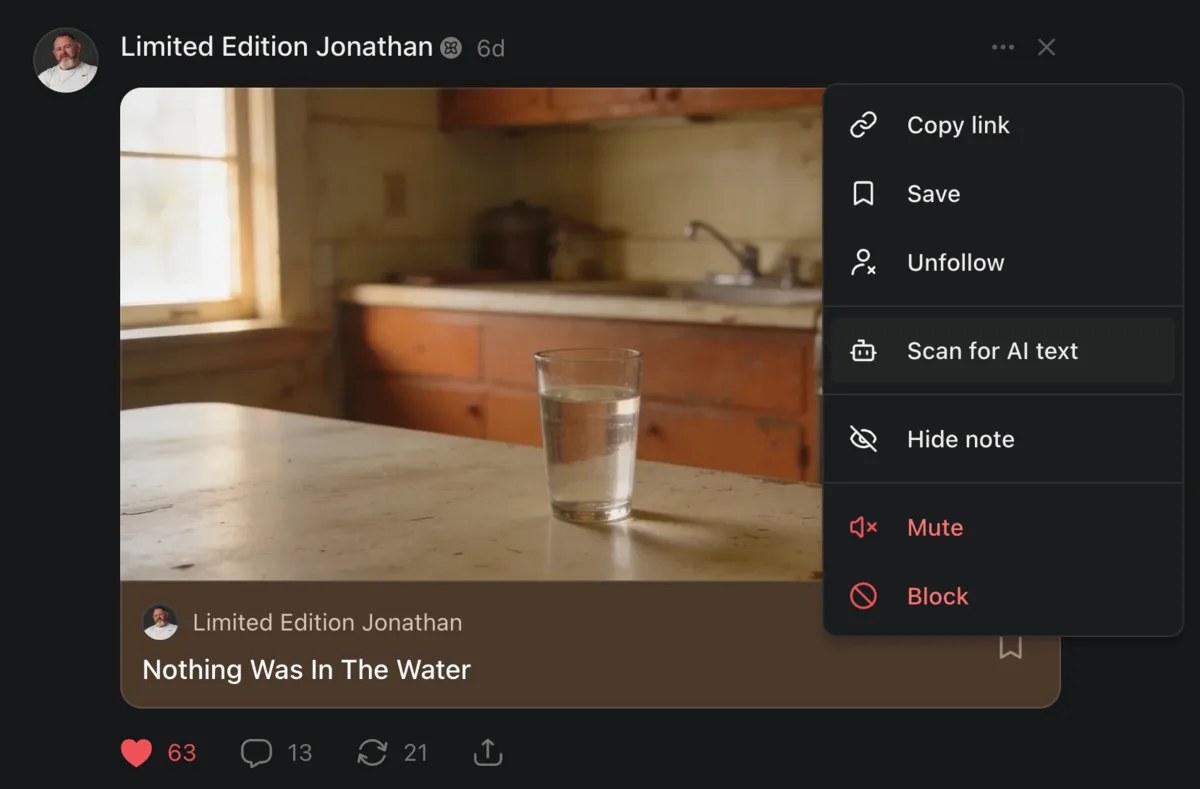
Substack shipped a "Scan for AI text" button. Click it and a detector reports whether a post is AI generated, AI assisted, or human. The writer is not notified. The appeal arrives after the label exists.
With this, three things are collapsing into one:
- Where the text came from. The button guesses.
- How it was made. Only the author can say.
- Whether it is any good. Nothing on the platform touches it.
Producing plausible language got cheap. Judging whether language means anything didn't move an inch. So we reached for the easiest proxy going, a guess about who typed it.
This isn't just about Substack. It's about a pattern emerging across platforms: a guess about origin, applied before anybody judged the work. That is a bias. It feels like discernment, and the thing being prejudged cannot be wronged. But the writer certainly can be. Most prejudice is inherited by accident and takes a generation to see. This one ships with a confidence score, a taxonomy, and an appeals process.
And a bias does real damage without needing to be right. Jonathan's anchor is a classic nocebo case. New York announced it was fluoridating the water. The rollout ran six weeks late, unannounced. On the day it was meant to start, people called in with headaches and stomach aches. Nothing was ever in the water.
A label does not have to be accurate to work. It only has to be believed.
➖ Subtraction: Cut Authorship Loose From Quality
Two approaches from this week's episode, unresolved on air. Take whichever fits you best.
Jonathan removes the signal. Subtract the AI-assisted label everywhere, including the voluntary kind. He held that before the detector existed: journalism has never owed its audience its sources, its editors, or its ghostwriters, and volunteering the information teaches readers there was something to suspect. His line: you are not entitled to my process.
I keep the signal and strip the quality meaning out of it. I disclose and plan to keep disclosing. But human-written is not a quality claim (never was), and machine-flagged isn't any better. Both are proxies, and flimsy ones at that.
The diagnostic, either way: the good-apple test. Take the last work you judged this week and write the standard it had to meet. Count the lines you can state without naming who or what typed it. Whatever survives is your real quality bar. The rest is origin in quality's clothing.
Watch, read, or listen
The full 24 minutes: YouTube. Every format in one place, including the complete transcript: sigsub.show/episodes/ep-005. Also on Substack and LinkedIn.
Jump to a segment: nothing was in the water · you are not entitled to my process · origin is not quality · what actually shipped
🍎 Analogy of the Week: A Catalogue of Varieties
Everything on the page is true. None of it is the thing you wanted to know.

There's a catalogue of antique apple varieties. Northern Spy, Cox's Orange Pippin, Esopus Spitzenburg, Roxbury Russet. Jonathan is on the list, a real variety, older than any of this. Beside the catalogue, a photograph of an apple, accurate and well lit. And beside that, an actual apple.
Neither says whether the flesh is mealy or whether it tastes like anything. For that, somebody has to eat it and say so.
We are running the whole conversation about writing from the catalogue. Which variety, which orchard, whether a machine was in the room. But the one property a reader came for has no button and no scan. Is the apple any good?
Knowing which variety it is never once told you it was a good apple.
🎵 Closing: Taste Testing
Here is what the label fight keeps stepping over. We can name what good means for a specific piece of work and measure it directly, at a cost that did not exist before. I laid the dimensions out in Writing Quality After AI: conceptual clarity, factual accuracy, whether the thing actually communicated. Observable, inspectable, open to challenge in a way a detector score never is. That is the tool nobody is picking up, because prejudging origin is easier than defining quality.
So carry the good-apple test into Monday. If you can't state your standard without naming who typed it, you didn't have a standard, only a leading indicator.
When someone asks how something was written, the answer worth wanting is still: very well, thank you.
This thread is not finished. As of today, August 2 2026, labeling AI-generated content is not a platform preference in Europe. It is law, with fines attached, and California's provenance rules reached generative AI providers the same morning. Jonathan wants the label gone; two jurisdictions just made a version of it mandatory. Wednesday we take the same question from the regulatory side, where the answer to a bad label is not an appeal button but a penalty. Guest: Michael Simon, on what the Act asks of an operator now that the labeling obligations are live. Join us live with your questions.
See you then,
Sam Rogers Taster & Labeler

New here? Subscribe at sigsub.show and the next episode lands in your inbox.
Related reading:
- The piece this episode is built on: Nothing Was In The Water by Limited Edition Jonathan
- The Substack announcement Jonathan is arguing against, Against Claudefishing by Substack CEO, Chris Best
- My essay Writing Quality After AI on Substack, as cited in this episode
- Rightness at Resolution (issue 034). Correct for what, at what resolution, which is the question a detector never asks.
- Synthetic Trust (issue 025). What happens to a trust signal once the signal itself is cheap to manufacture.
Get the next one
Free weekly newsletter on Substack. No account needed.
One signal, one subtraction, one analogy, every Sunday. Every issue, back to 001.