The Implied Price Recovery
What did you already decide it was worth?
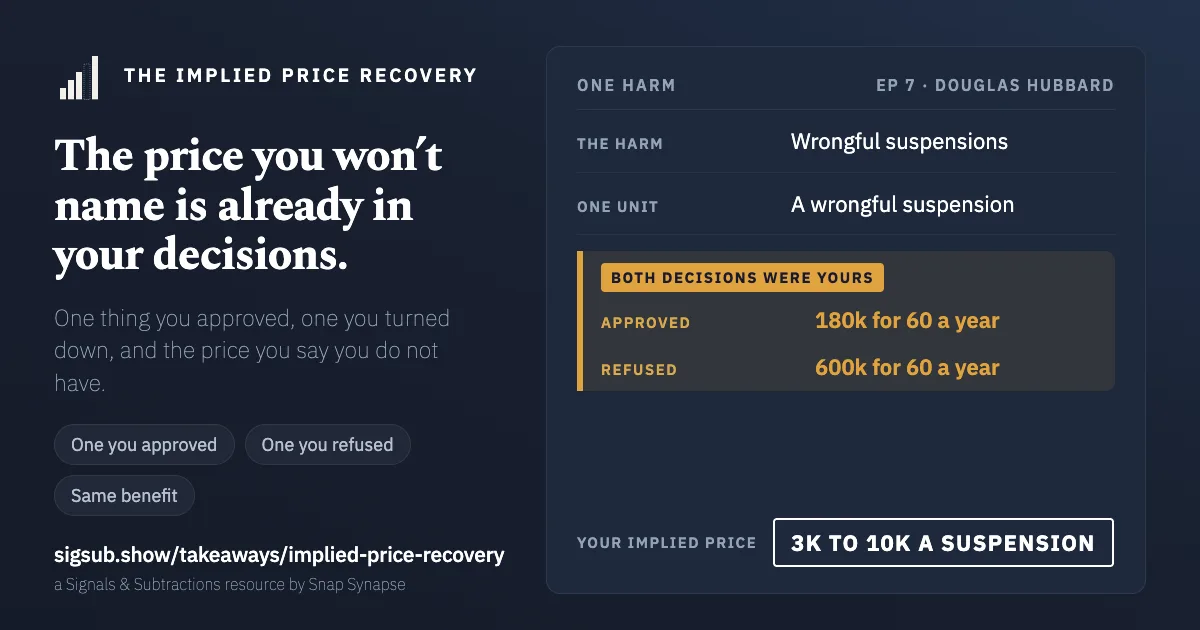
One approval, one refusal, the same harm. The gap between them is the price you keep saying you don't have.
The decision it forces
There's a harm you've said can't be priced. Maybe it's what a wrong answer does to a customer, or what an outage does to a reputation, or what one bad automated call does to somebody's month. Somebody asked for a number and we said the question was the wrong shape.
We've already answered it. Not in a meeting, in a budget.
Douglas Hubbard, on Episode 7, recorded in 2016, on the version of this that people get most indignant about:
I am putting a value on a human life just by virtue of even making those choices.
The argument, in his words
His route there is short, and it starts with the thing nobody disputes:
But we do have limited resources, and we have multiple big problems to solve.
Then the part that stings, about organisations that will tell you to your face that the number doesn't exist:
but in fact, when you look at the decisions they've made, they already have been.
And the mechanism, which is the whole of this page:
Anybody with access to their decisions and a little bit of algebra can figure out the implied value of a human life.
He's clear about why it's worth digging out rather than leaving where it is:
The problem is because it's only implied and not explicit, it changes every time.
That's the cost of refusing. Not that we price the thing badly, but that we price it differently on Tuesday than we did on Monday, for reasons that have nothing to do with the decision. He locates the argument in his own work, on the same tape:
In my first book, I make the moral argument that you have to measure these things.
Where the number comes from
Hubbard gives the shape of the recovery in one sentence on the episode, as a hypothetical somebody might say out loud:
This program which will save two lives a year on average is worth $5 million, but it's not worth 12 million because I rejected another project on that same basis.
Read that as two facts about the person saying it. They approved something, so their price is at least what they paid per unit of harm avoided. They refused something else, so their price is below what that one would have cost per unit. The number they say they don't have sits between those two.
Hubbard states both halves and never does the division. The bracket, the floor, the ceiling and the inconsistency rule below are the show's arithmetic on top of his argument, the same way the Verification Budget put multiplication on top of Paul Gibbons's ranges. The idea is his; the sum is ours.
The calculator
At least: not yet
And under: not yet
Unresolved. One approval and one refusal are needed, each with a cost and a count.
The fields
| Field | What goes in it | Who fills it |
|---|---|---|
harm |
The thing you've said can't be priced, in the words you'd use to a colleague | you |
unit |
One unit of that harm, in the singular. A wrongful suspension, an hour of outage, a person affected | you |
approved[].what |
Something you funded, at least partly to reduce that harm. One is enough; more sharpens the floor | you |
approved[].cost |
What it cost, in whatever currency you budget in | machine, or you |
approved[].reduction |
How many of those it actually took away in a year | you, and only you |
refused.what |
Something you turned down that would also have reduced it | you |
refused.cost |
What it would have cost | machine, or you |
refused.reduction |
How many it would have taken away, same unit, same year | you, and only you |
implied_price.floor |
The highest cost-over-count among the approvals | derived |
implied_price.floor_set_by |
Which approval set it, or null when only one was given |
derived |
implied_price.ceiling |
Refused cost over refused count | derived |
implied_price.verdict |
bracketed, inconsistent, or unresolved | derived |
This page carries no worked example beyond the schematic one on its card, because a filled recovery names a real thing an organisation decided not to pay for, and that belongs to whoever decided it.
The rule
The floor is what you demonstrably will pay. The ceiling is what you demonstrably won't. Three outcomes, and only one of them is comfortable:
- Bracketed. The floor is below the ceiling, and your price is in between. You have a number. Write it down and use it on the next decision, because you were using it anyway.
- Inconsistent. The floor is at or above the ceiling. You paid more per unit in one place than you refused to pay in another, for the same harm. This is Hubbard's "it changes every time", arriving as arithmetic. It doesn't tell you which of the two decisions was wrong, and neither does this page.
- Unresolved. One of the numbers is missing. Don't fill it with a plausible one. A missing count is a finding about what we know, not a gap in the form.
How the number is worked out
The whole of it, so nothing here is a black box.
Every approval gives us one fact: we were willing to pay its cost for the harm it took away. Divide the cost by the count and that's a rate we accepted. Do that for each approval, and the floor is the highest of them, because a price we have paid once is a price we have paid. It is never the average. An average would let a cheap decision talk down an expensive one we actually signed, and we signed it.
Every refusal gives us the opposite fact: we were not willing to pay its cost for the harm it would have taken away. Divide, and that rate is a ceiling.
floor    = max( approved[i].cost / approved[i].reduction )
ceiling  = refused.cost / refused.reduction

verdict  = unresolved    when either side is missing, or any count is zero
         = bracketed     when floor < ceiling
         = inconsistent  when floor >= ceiling
So extra approvals can only raise the floor, never lower it, which is why they're optional and why adding one either tightens the bracket or breaks it. Breaking it is not a bug in the arithmetic. It's the finding: a spend we approved at a rate we elsewhere refused is the inconsistency Hubbard is describing, and it was invisible until both decisions were written next to each other.
Hubbard sets this up at 20:56 in the episode, where he gives both halves and stops short of dividing them. The division is ours.
The schema
{
  "schema": "implied-price-recovery/v0.1",
  "harm": "",
  "unit": "",
  "approved": [
    {
      "what": "",
      "cost": 0,
      "reduction": 0
    }
  ],
  "refused": {
    "what": "",
    "cost": 0,
    "reduction": 0
  },
  "implied_price": {
    "floor": 0,
    "floor_set_by": null,
    "ceiling": 0,
    "verdict": "unresolved"
  }
}
The Copy JSON button above emits exactly this.
Run it with any model
If you'd rather be interviewed than fill a form, this does the same arithmetic. It may divide; it may never tell you how much harm a spend took away.
Help me recover the implied price I have already put on a harm I say cannot be priced, using two decisions I have
already made.

The arithmetic is fixed and you do all of it. For each thing I approved, divide its cost by its count to get a rate I
accepted; the floor is the HIGHEST of those rates, never the average. The ceiling is the refused cost divided by the
refused count. If the floor is below the ceiling, my implied price is between them. If the floor is at or above the
ceiling, my decisions are inconsistent. If either side is missing, or any count is zero, the result is unresolved.

INTERVIEW ME, two questions at a time.

1. harm: the thing I have said cannot be priced, in plain words.
2. unit: one unit of that harm, in the singular. Ask me for this before any money is mentioned.
3. approved[].what: something I funded at least partly to reduce that harm.
4. approved[].cost: what it cost. If I give you a budget line, an invoice or a quote, read the figure off it and show me
   where you got it.
5. approved[].reduction: how many of those it actually took away in a year. Ask me WITHOUT suggesting a number, a range,
   a percentage or a benchmark.
6. Then ask once whether there is another approved spend against the same harm, and repeat 3 to 5 for each one I give
   you. Stop asking when I say there are no more. One is enough to finish.
7. refused.what: something I turned down that would also have reduced the same harm.
8. refused.cost: what it would have cost.
9. refused.reduction: how many it would have taken away, same unit and same year. Same rule as above.

RULES YOU DO NOT BREAK
1. Never estimate either reduction figure. Those two numbers are the whole recovery, and a model supplying them hands
   back a price I never set. If I cannot give you one, record it as missing and return unresolved.
2. Never tell me my implied price is too high or too low, humane or callous, defensible or not. You produce a bracket.
   What it means is mine.
3. When the result is inconsistent, do not guess which decision was the mistake, and do not suggest which number to
   revise. Report both, in the order I gave them, and stop.
4. Do not invent decisions I did not make, and do not go looking for an extra approval that would move the floor
   somewhere more comfortable. Take the ones I give you, in the order I give them.
5. Report the floor as one of my approvals, by name, not as a number with no decision attached to it.
6. Do not ask for a customer name, a vendor name, a credential, or the contents of any incident. Amounts and counts are
   enough.

OUTPUT
Valid JSON matching the schema implied-price-recovery/v0.1 as published at
https://sigsub.show/takeaways/implied-price-recovery/, then one line giving the floor and which approval set it, one
giving the ceiling, and one plain sentence naming the verdict and nothing else.
The one the show adds
Hubbard was talking about utilities, governments and hospitals, in 2016. Sam, in the outro recorded ten years later, on where the same argument turns up now:
But they already have. They just haven't looked at it.
That's the whole transfer. The people explaining why a number can't be put on an AI harm are not refusing to price it. They're declining to read back the price they've already set, and the reading takes two decisions and a division.
Hubbard is not answering that, and never heard it. He was interviewed in 2016 and the application is the show's.
What a machine may never do
It can do every division on this page, and it can read a cost off an invoice, a budget line or a signed quote. That part is better done by something that doesn't get tired.
It may never supply either reduction figure. How much harm a spend actually took away is the judgment the whole recovery rests on, and a model that estimates it returns a price nobody set, which is the one thing worse than having no number at all.
It may never tell you which of two inconsistent decisions was the wrong one. The arithmetic can prove they disagree. Only a person can say which one we'd defend.
The part that's not optional
Pick the harm you're most confident can't be priced, not the one that's easiest to fill in. Then use the two decisions you actually made, including the one you'd rather not reopen.
If the bracket comes out inconsistent, that result is worth more than a tidy number would have been, and Hubbard's line is the reason: a price that moves on its own is the thing refusing to name it buys you.