Episode 21 · 2026-11-20
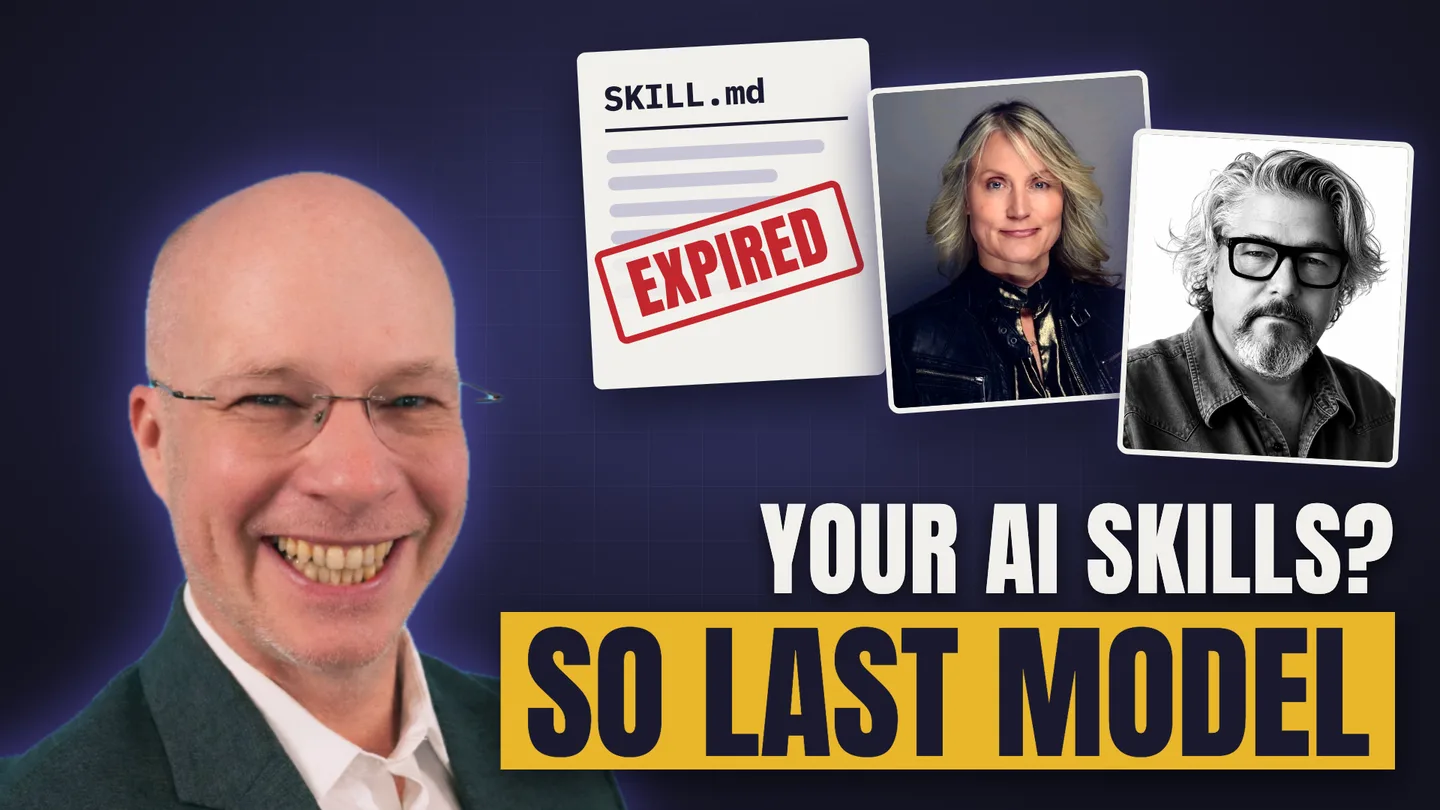
That's SO Last Model
The instructions we write for AI, from skill files to saved prompts, go stale with each new model, and nothing tells us.
Susan and Kingsley, the husband-and-wife e-learning builders behind Happy Alien AI, on why the skills most of us install describe what the model already knows, and why Kingsley's new course authoring app, Xogogy, ships with no AI inside.
Host Sam Rogers · guest Susan & Kingsley, the e-learning toolmakers · 30 min
A choice this episode can help with
Which of our team's AI instructions will still help the next model?
Run it on your own work: With and Without, one page, any model.
Watch it below, or read the conversation.
Premieres Friday 20 November 2026 on YouTube and in podcast apps. Open it on YouTube to set a reminder.
The signals
- Kingsley: Agents that work all night. Xogogy needed a tutorial for every feature, so he wrote the rules and a brief per video and let agents run: one drives the app through its MCP server, checks the code base and does a dry run first; evaluator agents check the script, the dry run and the finished video; another uploads to YouTube. "Overnight it makes like 10 different videos." And "the key is I didn't have to do anything." He still reviews wherever the board turns pink.
- Sam: The newest model made skills I relied on unnecessary. In July he read his 54 skills against one question: does this still add anything for the best models he uses? Eleven added nothing and nine were partly obsolete, some "burning more tokens to get to the same destination." With the newest releases from OpenAI and Anthropic, "I'm watching it happen again." What decayed was step-by-step instructions for how to think. The facts a model can't know and the scripts that do real work held.
The subtractions
- Kingsley: Installing other people's skill lists. "The way you're using skills is wrong," for most of us. The popular lists of 30 skills to install mostly describe what the model already knows: try the SCORM wrapper without its skill and "it does a good job all on its own." What earns a skill is what's bespoke: the three beats every one of his videos follows, which spreadsheet to use, and a Python file on his own machine that holds the credentials, never the skill itself.
- Sam: Treating skills as write-once. Some of what a team writes down for AI is built to last, like an approval process, and some is built for the current model. The second kind is "a maintenance cycle kind of item that is definitely less than annual." So "I'm evaluating my skills basically once a month now," and keeping the tests that answer Kingsley's question: how do we know it's actually better?
About this episode
Susan and Kingsley run Happy Alien AI, which builds AI tools and services that turn storyboards, decks and legacy courses into new ones. Before that, Kingsley led the team at ELB, formerly eLearning Brothers, that built MicroBuilder. Their new app, Xogogy, is a buy-once course authoring tool in beta.
Xogogy ships with no AI inside, and they gave three reasons. When Articulate made AI a mandatory, paid part of its tool, some customers simply couldn't use it where they work. The best model changes week to week, "and if you're locked into one, then that just means you can't enjoy all the benefits of all of them." And security: an MCP server lets the customer's own AI drive the app, so the work becomes watching what that AI asks for rather than defending a built-in chat box from prompt injection. A beta user wants it for a cleared government room, because the app doesn't call home. Having added MCP to their own fifteen-year-old product, they argue that building MCP-first from scratch is the advantage.
Then the question from the open: who owns what the team knows? Google Drive "may be secure, but it's not yours," and anything with someone else's logo on it "is not ours." Sam keeps a NAS of his own and still uses Drive and OneDrive. It isn't either-or; it's knowing which parts are truly ours.
One thing to do this week: pick one piece of know-how your team handed to an AI. Where does it live, and has anyone tested that it still helps? Then run that skill through With and Without: the same three jobs with it and without it, marked against conditions written first.
Links from the episode:
- Susan: LinkedIn
- Happy Alien AI
- With and Without: this episode's takeaway, a drill for whether a skill still beats the model without it
Want to bring your own signal and subtraction? Find yours.
Transcript
Read the conversation
Kingsley: for a while I was saying skills are dead, stop using skills. I'm gonna change that and say the way you're using skills is wrong, Not you particularly saying, but
Sam Rogers: Me? No.
Kingsley: Yes, yeah. I was watching what you were doing. And no, no, no. I would say that
Put it to work
Pick one piece of know-how your team handed to an AI. Where does it live, and has anyone tested that it still helps?
The method from this episode is one page with its copy-paste prompt and schema: With and Without, linked under the decision above. Every takeaway.
Keep the next choice in view
One signal, one subtraction and one analogy every Sunday. Five minutes, no video required.
Optional. Free on Substack, no account needed. Already on LinkedIn? Subscribe there.