The newsletter · Sunday 8 November 2026
Power Steering
Power steering took the work out of turning and left the wheel where it was. AI makers stopped asking what the work is for, so the steering is ours to put back.
One signal 📡 One subtraction ➖ One analogy 🛞
Created by Sam Rogers of Snap Synapse | Episode 19 with guest Paul Swift (aka Ai.chemyst) | The Sunday newsletter of the weekly show at sigsub.show
🛞 Analogy of the Week: Power Steering
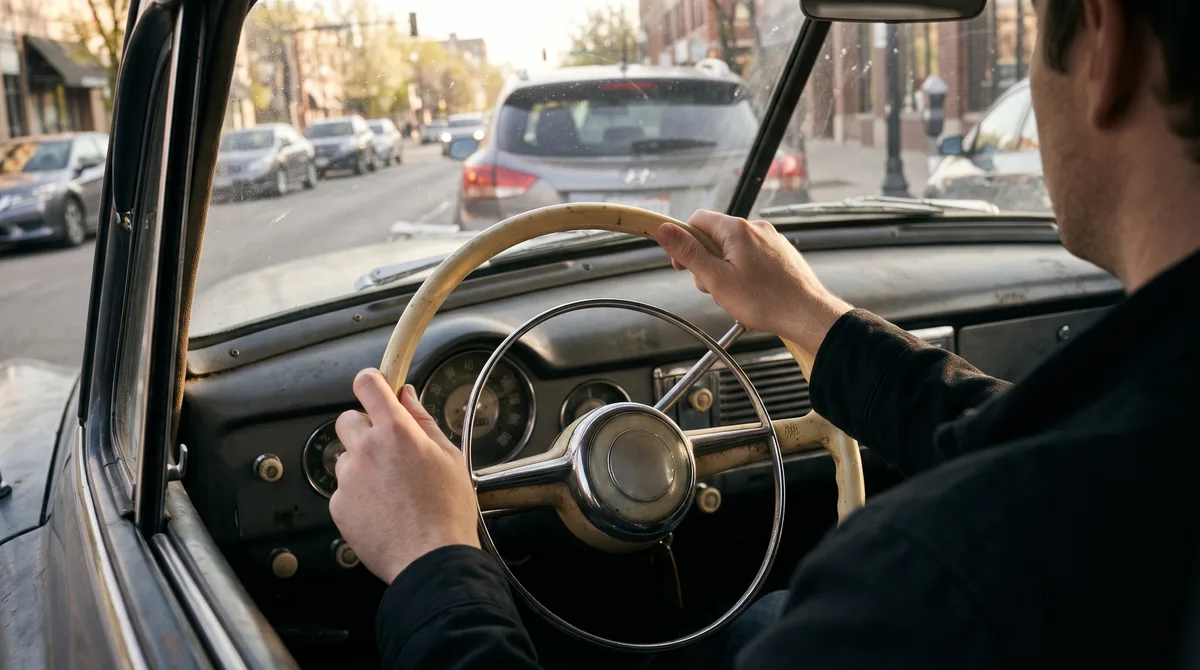
Anyone who's parked an old car without power steering remembers the workout: both hands on the wheel, leaning in, the tires grinding while the wheel fights back. Power steering, invented in 1926 and on a production car by 1951, took almost all of that effort away. But it didn't take away the steering wheel. The car still went where our hands pointed it.
Now some cars have no wheel at all. Zoox was cleared this summer to charge fares in Las Vegas for robotaxis with no steering wheel or pedals, and Tesla has been building its wheel-free Cybercab since spring. Even there, someone still names the destination, and the car handles every turn between here and there.
A one-shot prompt is that ride for AI: say where to go and get dropped off. For a street address, that's plenty. For a video, an essay or a piece of research, the turns are the work. Paul Swift (aka The Ai.chemyst) found that out and built a review desk that, he said, "puts the steering wheel back on." The model does the heavy turning. He picks where it goes, all the way there.
Power steering took the effort and left us the wheel. A one-shot prompt takes the turns, and nobody asks us about them.
📡 Signal: The maker stopped asking
Every good maker we've worked with asked first. The designer who wants to know who it's for. The junior analyst who comes back ten minutes in to ask what it's for, so they know when to stop. Those questions were the brief, pulled out of us by someone who needed it. On plenty of teams it was never written down anywhere else.
AI makers don't ask. They produce, and they produce well enough to look finished. Paul gave a model one of his older articles and a short prompt, and got back a six-minute video that "wasn't too far off in quality" from the one he eventually published. Then he caught himself "bug fixing after the fact," with his judgment arriving at the end, when it was most expensive to use.
His fix wasn't a better prompt, because it's "really hard to articulate and describe and define what you want when it's a visual or a video thing." He built a studio that does the asking: it rebuilds the video chapter by chapter, with a decision card at each step. He thinks of himself as "a bit of an active client." The studio's whole job is to make sure there is one.
The old makers pulled the brief out of us. The new ones don't ask, so nobody notices it's missing until the rework.
▶️ Watch, read, or listen
The full conversation with Paul, with the transcript and every format, is at sigsub.show/episodes/ep-019.
Jump to a segment: one-shot generation · the review desk · the steering wheel back on · four checks · the air gap · the first artifact isn't the product · the inverse Pareto · asking if it's sure · the harder hallucination · the watcher
➖ Subtraction: Asking the AI if it's sure
This week I delivered a lunch-and-learn with a Salt Lake City law office on four checks before an AI answer leaves the desk. One story anchors every talk like it: in 2023, a lawyer asked ChatGPT whether the cases it had given him were real. It said they were. They weren't (Mata v. Avianca). Most of the room knew that one. Fewer knew it's still happening, in Utah's Court of Appeals in 2025 and in federal court in Utah this September.
As I said on the show, "whenever you're asking the AI if it's sure, it's almost always a yes," because "it doesn't blink red when it's making stuff up." Back in Better Boiled Water, the rule was that a tool's opinion of itself doesn't count, and "are you sure?" asks for exactly that opinion. So I've subtracted the question. In its place: the exact line, and where it lives. Then we open it and read it ourselves.
Before the lunch, I ran one Utah legal question through five AI systems, six times each, half of them asking for every case's quote and pinpoint. Those answers were much easier to check. They weren't reliably right, because a real citation can still rest on a misreading. Paul called that the harder kind: real sources taken a little out of context, and "as written, it's quite indefensible."
What we get back is an answer we can check, instead of one that only reassures us.
Asking if it's sure tells us how the answer sounds. Asking for the line tells us what it found.
🧭 Take It to Work
Both beats are the same move at two ends of the work. Before AI does the making: who's the client? After it comes back: show me the line. Every answer from my testing, with its prompt, is in the record from that lunch.
This week's takeaway, What It's For, is the first half: four lines, written by people before the work starts, for what it's for, who asked, what done looks like and who answers. It's a studio with decision cards, modeled on the review desk Paul showed in the episode. When what comes back cites anything, Four Checks Before It Leaves Your Desk is the second half.
Who on your team used to ask "what's this for?", and is anyone still asking it now that AI writes the first draft? Send me your answer, or bring it to the show.
The assist is only going to get stronger. That's fine, as long as somebody's still steering.
Both hands on the wheel,
Sam Rogers Licensed to Steer
New here? Subscribe at sigsub.show and the next episode lands in your inbox.
Somebody on your team still asks "what's this for?" before they start. Forward this to them, with thanks.
Related reading:
- Synthetic Trust (025): stop treating confidence as evidence. This week, the confidence is one word: yes.
- No Wrong Answers (067): set the bar before seeing the output. What It's For writes that bar down, along with whose it is.
- Better Boiled Water (073): the tool's opinion of itself doesn't count. This week, that rule applies to a single answer.
- Every episode's takeaway: sigsub.show/takeaways.
This week's guest: Paul Swift, whose write-up of the studio, Article-to-video studio, shows the review desk in full.
Get the next one
Free weekly newsletter on Substack. No account needed. Already on LinkedIn? Subscribe there.
One signal, one subtraction, one analogy, every Sunday. Every issue, back to 001.