Episode 19 · 2026-11-06
Put the Steering Wheel Back On
A model can make the whole video in one prompt. The judgment it skipped is still ours to put back.
Paul Swift, Ai.chemyst on Substack, made a six-minute video in one prompt, then rebuilt it chapter by chapter in a studio he built himself, so his judgment came in at the start, not the end.
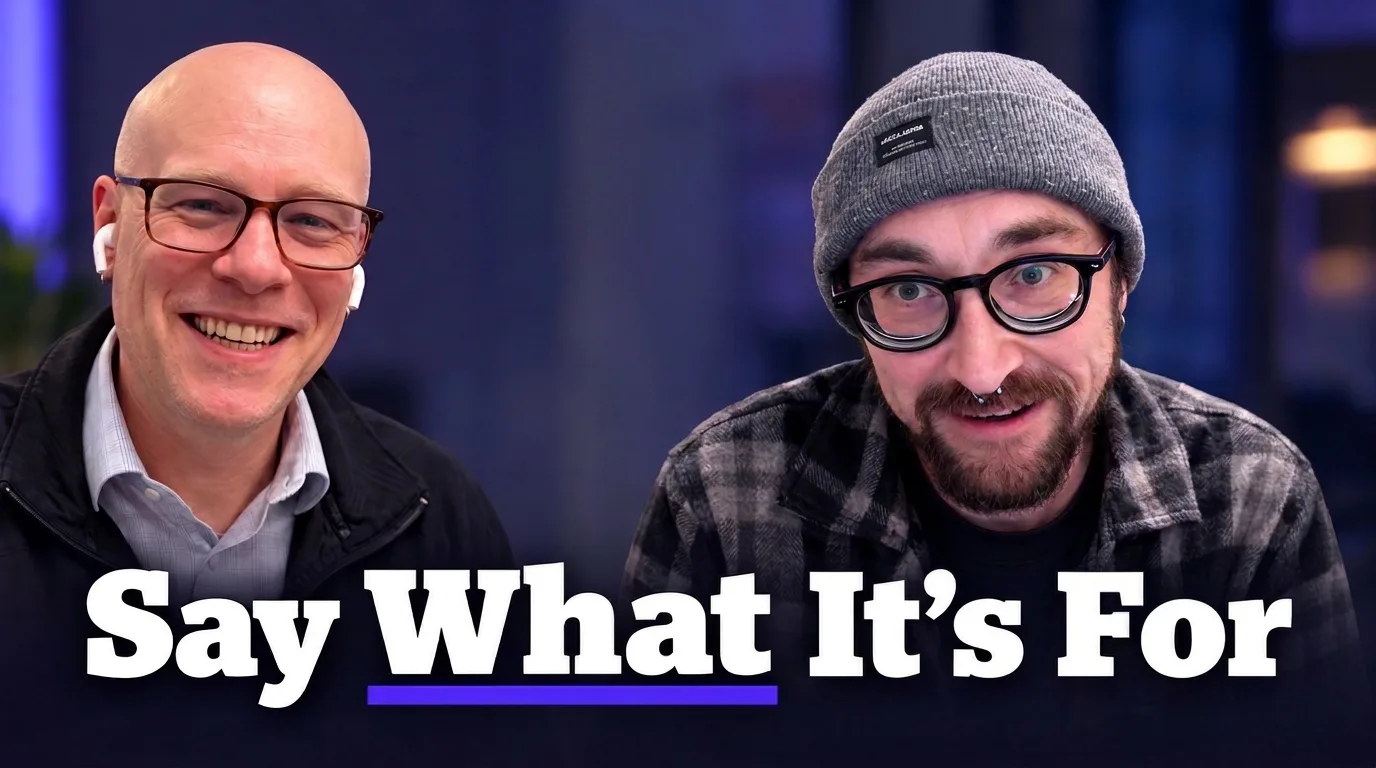
Host Sam Rogers · guest Paul Swift, the self-taught builder · 30 min
A choice this episode can help with
When AI does the making, who's the client in your organization?
Run it on your own work: What It's For, one page, any model.
Watch it below, or read the conversation.
Listen
Or follow the show on Apple Podcasts, Spotify, or in any podcast app.
The signals
- Paul: One-shot generation is good enough to start from. Nearly every day on X he sees people posting whole games and multiplayer 3D worlds built in four hours. He gave a model one of his older articles and a short prompt, and it built a six-minute explainer video that "wasn't too far off in quality" from the one he eventually made. Then he found himself "bug fixing after the fact," putting his judgment in at the end. So he took that video into a new session and rebuilt it "chapter by chapter as a review desk, as a studio, with surfaces that I can add my judgment in." The studio shows him decision cards rather than asking him for a long prompt, because "it's really hard to articulate and describe and define what you want when it's a visual or a video thing," and at the end of every review desk "it automatically compiles the prompt for me."
- Sam: Four checks before an AI answer leaves your desk. From a lunch the same day with a room full of lawyers. Does the source exist? Does it say what the summary claims? What date is it from, since an answer that was accurate in 2022 can miss a case filed last month? And who owns it: "AI can do a lot of things for us, but what it can't do is own things for us." Those checks are the floor, the line beneath which nothing passes. Paul's studio is the ceiling.
The subtractions
- Paul: Treating the first artifact as the product. He still one-shots plenty, as the proof of concept. What he's dropped is the habit of shipping it because it looks polished: "I've stopped treating the first thing as ready." The version that came out of the studio had his decisions in it, and that's what let him say "I'm happy to put my name on this." The same goes for an essay or a piece of research, where fluent prose makes it hard to find anything to comment on. The one-shot gets him 80 percent; he spends his own effort on the 20 percent in the studio, which Sam named the inverse Pareto principle.
- Sam: Asking the AI if it's sure. "Whenever you're asking the AI if it's sure, it's almost always a yes," because "it doesn't blink red when it's making stuff up." He's replacing the question with a request for the exact quote and where it lives: "show me the exact line, show me where it lives." Then open it and read it for ourselves.
About this episode
Paul Swift is a dietitian by day who writes The distil_AI_tion on Substack as Ai.chemyst, with no engineering background: "just been wildly curious and open to experimenting." His studio runs in Claude Code, and he showed it on air at chapter seven, round four.
The cold open is Paul's rule for anything that can't be undone: "for anything consequential, always have an air gap." Nothing is sent by an agent if it's serious, "don't give it the send button unless there's a reverse button." Sam's version, from security: "either it's architecture or it's broken," and the more of it that's permissioned infrastructure the better, which came up last week in Episode 18 with Tim McAllister.
On hallucinations, Paul worries least about the source that doesn't exist, since a dead link gives itself away. The harder kind is a paragraph stitched from three real sources, each taken a little out of context, so the claim cites well and still can't be defended. His answer is three roles: a generator, a verifier that checks the claims exist, and a validator that checks whatever the verifier changed. Sam runs a fourth role in Harnessie, a watcher and logger on a local model that every other AI can read "but they cannot write to it." Paul started building one in the last week or two and called it the Watcher. Sam's point that Paul hadn't thought about: agents act differently once they can see they're being logged.
One thing to do this week: pick one AI-assisted piece of work your team shipped last week. Who said what it was for, and who answers if it's wrong? Then, before the next piece starts, fill in What It's For: what it's for, who asked, what done looks like, and who answers.
Links from the episode:
- Article-to-video studio: how I'm breaking into new territory with Claude Code: Paul's write-up of the studio and the review desk
- What It's For: this episode's takeaway, four lines written by people before the work starts, built as a studio with decision cards after Paul's review desk
- Four Checks Before It Leaves Your Desk: Sam's four checks as a card to run before any AI answer goes out
- Harnessie and PAICE.work, where Sam splits the roles across competing model families
- Paul Swift: Ai.chemyst on Substack
- Earlier episodes called back: Episode 18 with Tim McAllister on permissioned infrastructure, and Episode 14 and Episode 5 with Limited Edition Jonathan, whose post about salespeople pitching ninety times Sam brought up
Want to bring your own signal and subtraction? Find yours.
Transcript
Read the conversation
Paul Swift: for anything consequential, always have an air gap. meaning nothing
Sam Rogers: Yes.
Paul Swift: leaves nothing is sent by an agent or anyone if it's serious. it can only be generating and producing things. But it but don't give it the send button unless there's a reverse button
Put it to work
Pick one AI-assisted piece of work your team shipped last week. Who said what it was for, and who answers if it's wrong?
The newsletter
Issue 76 · Sunday 8 November 2026 · sent on Substack and LinkedIn.
One signal, one subtraction, one analogy, in five minutes. It draws on this episode but stands on its own. Every issue.
The method from this episode is one page with its copy-paste prompt and schema: What It's For, linked under the decision above. Every takeaway.
Keep the next choice in view
One signal, one subtraction and one analogy every Sunday. Five minutes, no video required.
Optional. Free on Substack, no account needed. Already on LinkedIn? Subscribe there.