The newsletter · Monday 20 July 2026
The Crowded Bar
AI made every resume look great, which is exactly why looking great stopped meaning anything. Put the human back.
One signal 🔭 One subtraction ➖ One analogy 🍸
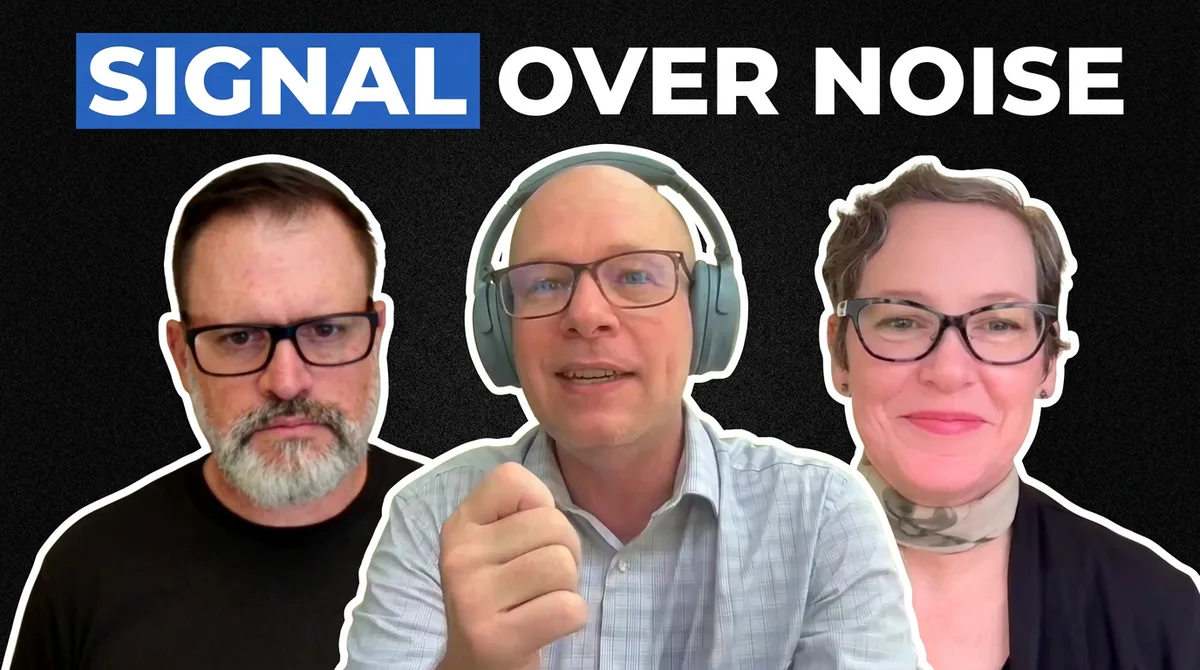
Created by Sam Rogers, building PAICE.work | Episode 3 with cohost Lee Rodrigues and guest Christine Rodrigues | The Sunday newsletter of the weekly show at sigsub.show
🔭 Signal: The Resume Stopped Being a Signal
For as long as there have been resumes, a good one meant a good candidate, the same way good writing meant a good writer. A hiring manager could look down the pile and sort: that one is strong, interview them. That shortcut is gone.
Now anyone can paste a job description into a chatbot and get back a polished resume that matches it word for word. Everyone using the same tool on the same posting lands on the same phrasing. Christine Rodrigues, who coaches job seekers to run their search like a marketing campaign, named the trap exactly: the polish AI gives your writing is an anesthetic. It looks great, and that numbs you to whether anything underneath is actually there.
The machines are strongest in the middle of the distribution and weakest at the edges; the Mount Sinai ChatGPT Health study showed exactly that with medical questions. So a generated resume pulls you toward the average of every resume out there. That is perfect if you want to disappear into the pile, and fatal if you want to be one of the five people who get called. When 500 applications arrive in 48 hours, the reviewer is not hunting for reasons to say yes. They are hunting for reasons to say no.
When everyone can look great, looking great stops meaning anything.
➖ Subtraction: Stop Sending What You Can't Defend
Cut the button-push application. Every bullet a chatbot writes for you is a story you will be asked to tell out loud in the interview, and if you did not write it, you did not rehearse it. You become the kid giving a book report on a book you never read, and it shows in the first follow-up question.
Here is the named diagnostic: the defend-it test. Go down your resume line by line and count the bullets you could not talk about, unscripted, for a full minute. Every one you cannot defend is one the machine wrote, not you. Rewrite it in your own words or take it off.
A resume you cannot defend is not an asset. It is a trap you set for yourself.
Watch, read, or listen
The full 28 minutes: YouTube. Every format in one place: sigsub.show/episodes/ep-003. Also on Substack and LinkedIn. Podcast on Apple and Spotify, once live.
Jump to a segment: the resume as broken signal · what AI is actually good at · the numbers game
🍸 Analogy of the Week: The Crowded Bar
You don't need to meet everyone in the room.

Lee Rodrigues put it the way only Lee would: firing the same tired opener at ten people across the bar instead of two does not change your night. You just get turned down ten times instead of twice. The easy-apply button is that opener at scale. A thousand identical, generated applications hit the same overwhelmed recruiter who closes the posting an hour after it goes up, and the volume is the tell that none of it was meant for them.
A job search does not need to scale. It needs to reach the right people, which is almost always a smaller number reached through a warmer channel: a phone call, a referral, a real conversation outside the herd. That is the one move a machine cannot make for you, and it is the move that still works.
You don't need everyone at the bar. You need the one conversation worth having.
🎵 Closing: Put the Human Back
Every thread this week ran to the same place. AI raised the quality floor, which raised the noise floor right along with it, and the only signal left is the part that was always human: the original thought, the voice, the judgment, the willingness to pick up the phone. Christine calls it thought sovereignty. It is not a rejection of the tool. It is refusing to hand the tool the one thing that makes you worth hiring.
So carry the defend-it test into Monday: which line on your resume could you not talk about for sixty seconds, and who wrote it, really?
Next week we move from the seeker's side of the table to the defender's: the CISO's view of AI, where the same question about what you are quietly handing over gets a lot sharper.
See you then,
Sam Rogers Last Call on Noise

New here? Subscribe at sigsub.show and the next episode lands in your inbox.
This week's cohost: Lee Rodrigues, who brought the hiring-manager and instructional-design view from the other side of the table, with guest Christine Rodrigues of System2Focus.
Related reading:
- Easy, Awry. The comedic receipt: one-click job applications were already breaking the funnel nearly a year ago.
- Tools Takeover Talent (017). The hiring side of this story: what changes when the tools start doing the sorting.
- Skills Ain't What They Used to Be (041). When the signal a skill used to send gets cheap to fake, you have to prove it differently.
Presented by System2Focus, Lee and Christine's workflow-based approach to the job search (a product of R&P Associates). Strategy over spray, signal over noise, which is the entire pitch and the whole of this episode.
Get the next one
Free weekly newsletter on Substack. No account needed.
One signal, one subtraction, one analogy, every Sunday. Every issue, back to 001.