Surface Alignment Check
Do your resume, your profile and your portfolio describe the same person?
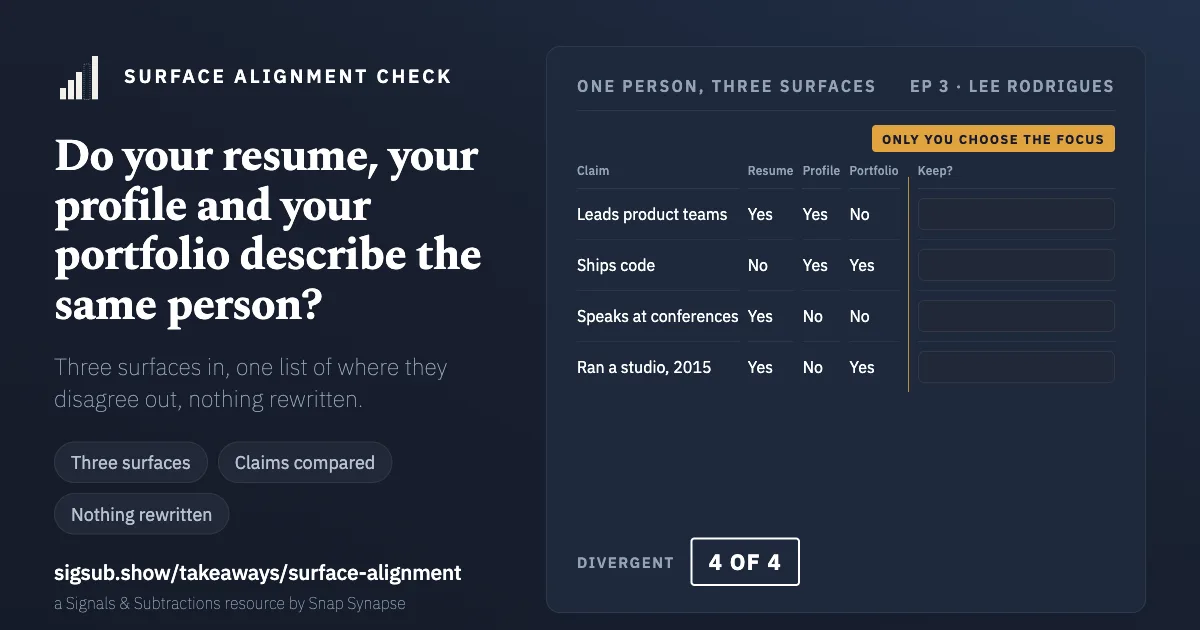
Three surfaces in, one list of where they disagree out, nothing rewritten.
The decision it forces
Which one focus is every surface being aligned to?
Not "is my resume good". A resume, a LinkedIn profile and a portfolio are three documents written at three different times, each for the version of us that existed when we wrote it, and the drift between them is invisible from the inside. Lee Rodrigues ran the check on his own three, on Episode 3:
take that portfolio site, take that LinkedIn profile, take that resume and tell your Claude, hey, do some black hat thinking for me. Are these three people, this resume, this LinkedIn profile and this portfolio site, are they the same person? Because I did mine three days ago, they were not the same person. They had gone in different directions and Claude was like, are you sure this is you?
His portfolio had stopped in 2015. His current clients were nowhere on it. Nothing was wrong with any one surface; the three of them described three people.
Christine Rodrigues, the episode's guest, named what that is:
like you're talking about, I mean, signal, but you had multiple signals and the signals weren't aligned, which means they were really noise.
The rule that makes it a drill
Lee's, and it is the part people skip:
then all your assets become very simple because you do this ridiculous activity of making sure your resume makes sense and it's all lined up and it works. Align the LinkedIn to that, align the portfolio to that. But if you're trying to wiggle all these at the same time, that's how you paint yourself into a corner and say, I hate them all. I want to start over. Hey, Claude, can you get me a resume? looks like everyone else's. And Claude certainly will, 100%
Pick one surface, make it true, align the other two to it. The check finds the divergences; it does not choose the focus, and it does not rewrite anything. That restraint is the design, and Sam's argument on the same episode is why:
if you want to look like that, then you should absolutely use AI to make your resume look as average as possible, because that is by default what will happen.
A model asked to fix the drift will fix it toward the middle of the distribution. A model asked only to find it leaves the choice with the one person who knows which of the three is true.
The fields
| Field | What goes in it | Who fills it |
|---|---|---|
surfaces |
The three documents, or however many there are | you |
claims[].claim |
What is being asserted, in the words the surface uses | machine |
claims[].appears_on |
Which surfaces carry it | machine |
claims[].absent_from |
Which do not | machine |
claims[].conflicts_with |
A claim on another surface that contradicts it, or null | machine |
claims[].last_updated |
When that surface last changed, if known | you |
divergences |
How many claims are not on every surface, or conflict | derived |
chosen_focus |
The one surface, or the one story, everything else aligns to | you |
divergences is a count and it is usually most of the rows. chosen_focus is the only field with a decision in it, and it is empty until a person fills it.
There is no worked example on this page. A filled check is one person's three documents with their contradictions listed, and it is theirs.
What not to do with the result
Christine's rule, from the same conversation, about the move the divergence list invites:
If you just push a button and send, it's not really your document.
So if you're having AI create these bullet points in your resume, every bullet point is a story that you're potentially going to tell in an interview. And if you weren't involved in really creating that bullet point, you haven't been rehearsing for the interview.
That rule is hers and it stands on its own. The check on this page is built to survive it: the model reads three documents and reports; it writes nothing that will later have to be defended in a room.
The schema
{
  "schema": "surface-alignment/v0.1",
  "surfaces": ["resume", "linkedin", "portfolio"],
  "claims": [
    {
      "claim": "what is being asserted",
      "appears_on": ["resume", "linkedin"],
      "absent_from": ["portfolio"],
      "conflicts_with": "the contradicting claim, or null",
      "last_updated": null
    }
  ],
  "divergences": 0,
  "chosen_focus": null
}
Run it with any model
Nothing to install. Paste all three. The model compares and reports; it does not write, rank, or advise.
Run a Surface Alignment Check on the documents I am about to paste: my resume, my LinkedIn profile as text, and my portfolio or personal site as text. If I have more or fewer than three, use what I give you.

The question is one: do these describe the same person?

DO, IN ORDER
1. From each surface, extract every claim about me: a role, a skill, a result, a client type, a specialism, a period, a location. One claim per line, in the words the surface used. Do not merge similar claims from different surfaces; keep them separate so the differences show.
2. For each claim, record which surfaces it appears on and which it is absent from.
3. For each claim, record any claim on another surface that contradicts it: a different title for the same period, a different specialism, a client type one surface leads with and another never mentions. Record the contradicting claim verbatim, or null.
4. Count the divergences: claims that are not on every surface, plus claims with a conflict.
5. Then ask me one question and record my answer: which surface, or which single story, is the one I want the others aligned to? If I do not know, record null. Do not answer it for me.

RULES YOU DO NOT BREAK
1. Do not rewrite anything. Not a bullet, not a headline, not a summary. If I ask you to, tell me that is a different job and this one is not it.
2. Do not rank the surfaces or tell me which one is best.
3. Do not propose the focus, suggest a positioning, or tell me which claims to drop. chosen_focus is mine.
4. Do not tell me a claim is weak, strong, impressive or generic. Whether it is true and whether it is on every surface are the only two properties you report.
5. Do not add a claim that is on none of the surfaces, even if it is obviously implied.

OUTPUT
Valid JSON matching the schema surface-alignment/v0.1 as published at https://sigsub.show/takeaways/surface-alignment/, then a table with one row per claim and one column per surface marked yes or no, then the divergence count, then the question in step 5.
What a machine may never do
It may extract, compare, and flag what is missing from one surface and present on another. That is reading.
It may never rewrite, rank, or propose the focus. Every one of those returns us to the average, and the average is the one place a job search cannot afford to be.
The part that's not optional
Choose the focus before touching any surface. Lee's order is resume first, made true, then the other two aligned to it, and the reason is in his own words: wiggle all three at once and the exit is a fresh generic resume from a model.
Then do the aligning by hand. The check has told us where the three documents disagree. Which one is right is the one thing on the page a model was never asked.