The Right Ten
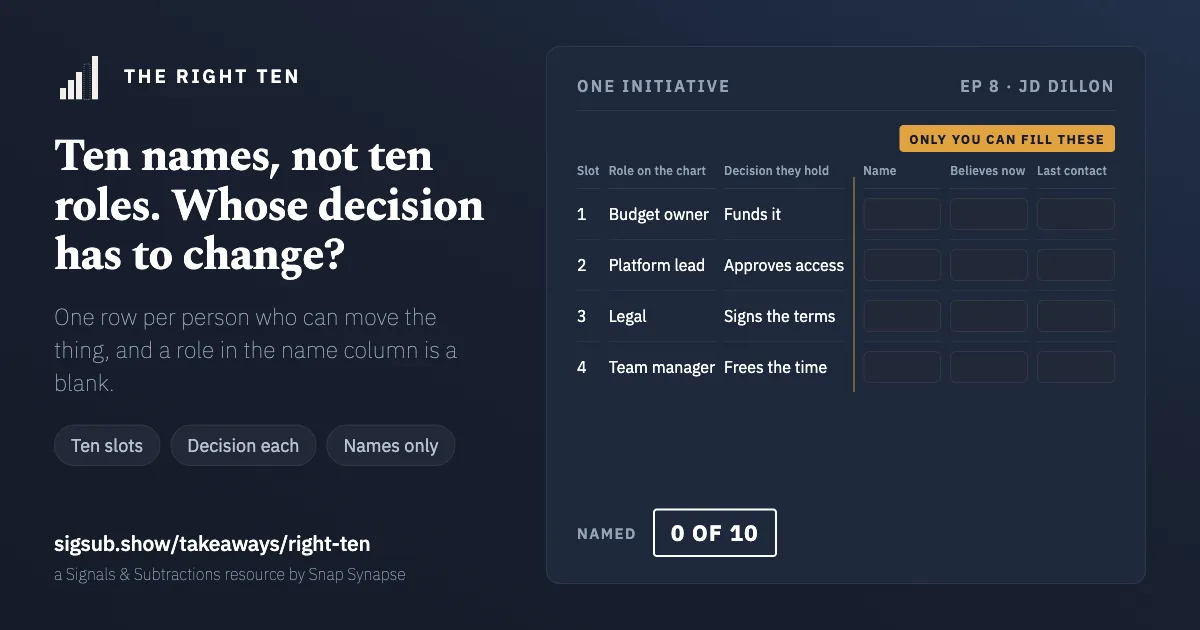
Ten names, not ten roles. Whose decision has to change?
One row per person who can move the thing, and a role in the name column is a blank.
The decision it forces
Whose decision has to change for this to move?
Not who should know about it. Not who would be supportive. Whose decision, held by a person with a name, has to be different on a Tuesday for the initiative to be somewhere it is not today.
JD Dillon, on Episode 8, on how he stopped choosing rooms by size:
And I picked topics, again, topics where I had some insight to share and there was going to be valuable conversation. But I, made decisions and prioritize things based on the biggest room. right. The biggest audience, most exposure, which is good. There is a branding element to it and awareness element to it. So there's some value to that, but I've over time realized like, I'd rather have a conversation with the right 10 people than the wrong thousand people.
That is his subtraction, and the concession in the middle of it is his too: reach is not worthless, it is just not the thing that moves anything. This page is what the sentence implies if we take it literally: a list of ten, by name.
Why ten names and not the ten most senior
Sam's signal on the same episode, which he named on air as his own:
Something that I've been observing over the last year or so, but it's kind of flipped lately, which is expertise inversion, is what I'm calling it.
Now more and more we're seeing folks who maybe don't have a a senior title. They don't have seniority in the organization. But those who really have solid AI skills and who are able to move quickly and provide information to the business
The org chart routes attention by the old map, where seniority and expertise were the same thing. If the ten on the list are the ten most senior people, the list is the org chart with the boxes renamed. The question for each slot is not "who is in charge of this" but "who holds the decision that has to change", and those are increasingly different people.
The fields
One initiative per list. Ten slots, because the number is JD's and because a list of forty is a distribution list.
| Field | What goes in it | Who fills it |
|---|---|---|
initiative |
What has to move, in one line | you |
role |
How the person is described on the org chart | machine, or you |
decision_they_hold |
What they can approve, block, fund, or free up | machine, or you |
name |
The person. A name, not a role, not a team, not a committee | you |
currently_believes |
What they think about this today, in their words if you have heard them | you |
what_would_move_them |
What they would have to see, hear or be shown | you |
last_contact |
When you last spoke to them about it. A date, or blank | you |
totals.roles_only |
Slots with a role and no name | derived |
roles_only is the honest number. Ten roles and zero names means we have an org chart, not a plan, and the finding is the blank column, the same rule Name the Human applies to its accountable field.
There is no worked example on this page. A filled list is ten real people and what we believe about them, and it belongs in a notebook, not on a website.
The other proof on the episode
The guest, Josh Felix, got where he got by the opposite move, and the episode never squares the two:
Every call can have absolutely no agenda. You're having a simple conversation. And you're gonna ask those individuals can I record the conversation? Recorded 64 conversations. I took all 64 conversations and I dumped them into AI tool.
Sixty-four conversations with anyone who would take a meeting is breadth, not ten. It is also how he found out what he was for, which is the input this list needs before it can be filled. One honest reading is that the sixty-four come first and the ten come out of them. Nobody put that to JD on air, and the page does not pretend it was settled.
JD's own question, the one he says he uses in conversations now, is the one to ask before the first slot is filled:
I'm using in a lot of conversations now is what do we really do here? Or what do
The schema
{
  "schema": "right-ten/v0.1",
  "initiative": "what has to move",
  "people": [
    {
      "name": null,
      "role": "how they are described on the org chart",
      "decision_they_hold": "what they can approve, block, fund, or free up",
      "currently_believes": null,
      "what_would_move_them": null,
      "what_you_would_have_to_show": null,
      "last_contact": null
    }
  ],
  "totals": { "slots": 10, "named": 0, "roles_only": 0, "contacted": 0 }
}
Run it with any model
Nothing to install. The model holds the structure and asks. It may never name a person, and it may never guess what one believes.
Help me build a Right Ten list: the ten people whose decision has to change for one initiative to move. Not who should know about it. Whose decision.

INTERVIEW ME, three questions at a time.

1. initiative: what has to move, in one line. If I describe a project, ask me what decision, made by whom, would mean it had moved.
2. For each of ten slots, in this order: decision_they_hold first (what someone can approve, block, fund, or free up), then role (how that person is described on the org chart), then name. Ask for the decision before the role, and the role before the name, so the list is built from decisions outward rather than from the org chart down.
3. For each named slot only: currently_believes, in their words if I have heard them, and what_would_move_them. Then last_contact as a date or blank.

RULES YOU DO NOT BREAK
1. Never name a person. Never suggest one, never infer one from a title, a public directory, an org chart I paste, or anything else. If I give you a role or a team for the name field, tell me that is a blank and leave it null.
2. Never fill currently_believes or what_would_move_them. Guessing what someone believes is the thing that turns this from preparation into manipulation, and it is not allowed here.
3. Do not tell me who is important. If I fill the list with the ten most senior people, ask me once, for each, what decision they actually hold on this, and record what I say.
4. Do not ask for anyone's contact details.

OUTPUT
Valid JSON matching the schema right-ten/v0.1 as published at https://sigsub.show/takeaways/right-ten/, with totals for slots, named, roles_only and contacted. Then the same as a table with the three human columns left visibly empty where they are empty. Then one line: how many of the ten are named, and how many of the named ten I have spoken to in the last month.
What a machine may never do
It may prompt for the ten slots and hold the structure, and it may help name the decision each slot holds.
It may never name a person, and it may never fill currently_believes. The first turns a list into a guess; the second turns preparation into manipulation, and it is worth saying that on the page rather than trusting it to be understood.
The part that's not optional
Fill the name column alone, in one sitting, and count the blanks. Then, for every blank, ask whether the slot describes a decision or a department. A department cannot change its mind.
Then have the conversation with the first named person before touching the list again. JD's line is about conversations, not lists; the list is only how we make sure the conversation is with the right one.