How Worried, About What
More fire trucks, or a new playbook?
An old problem at a new size, or a new kind? One row per threat, read three ways: felt, response, assessed.
Which threats need more fire trucks, and which a new playbook?
For whoever has to decide what to do about AI risk. You bring the AI threats people are raising, and what we're doing about each·45min·any model·inventory
It ends in: sorted, unowned, no playbook, not triaged, or not assessed
Watch the two-minute walkthrough 2:32
A two-minute walkthrough: more fire trucks or a new playbook, the five levels, the three readings of each threat, the verdict, and how to run the prompt in any model.
The decision it forces
Which of the threats in front of us needs more fire trucks, and which needs a new playbook?
Someone's worried AI will take their job. Someone thinks the vendor trains on our data. Security says the agents can be talked into things. Each gets felt one way, answered another, and is, on the evidence, something else again.
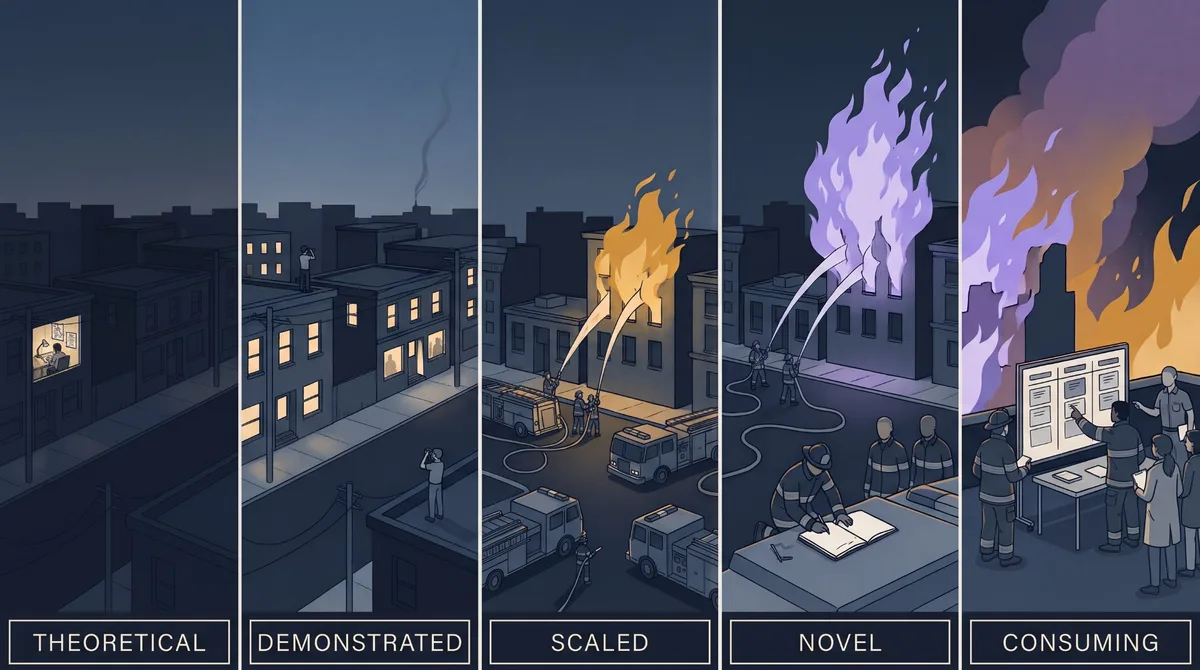
The SNAP Panic Scale, published at snapsynapse.com on 4 December 2025, sorts a threat into five levels, and its point is the jump from the third to the fourth. Picture each threat as a fire, and us as the fire department. Scaled is a fire we know how to fight, at any size: it needs more fire trucks, even if we have to find them. Novel is a fire that doesn't respond to water, where more fire trucks may make it worse. Each row's level is its answer, and the list's verdict says whether every row has its next action.
To run it, copy the prompt below into any model you already use.
When the old playbook stops working
On Episode 4, at 13:00 in the transcript, Sam put the problem in one line, about trust:
AI is much more like people than it is like computers.
Most of our playbooks were written for computers, systems that do the same thing every time. Some AI threats are old problems at a new size. Some aren't, and for those the usual response is the wrong tool. Sabino Marquez, a career security leader, described what that looks like from the inside, about compliance before AI (2:32):
And what I found was that the more compliance you did, the less safety you could prove you were providing.
That's the signature of a Novel problem treated as Scaled. AI security is the case that prompted this page: many organizations are answering it as Scaled, with more tools and faster patching. Sam's own read, as of October 2026, is that it's Novel, and could become Consuming, the fifth level, within about eighteen months. The page doesn't ask anyone to share that view.
The people raising these threats have feelings about them. That they have those feelings is a fact, owed respect on its own terms: nobody should be argued out of a worry or told it's silly. The feeling itself isn't a fact, however strongly it's felt. For deciding what to do next, it's one more source of information, alongside what we're already doing and what the evidence says. So each row carries three readings and keeps them apart.
The fields
One row per threat, for one group: a team, a function, a client. A threat nobody has raised still gets a row. Each row is read three ways: felt, response and assessed.
| Fields | What they hold | Who fills it |
|---|---|---|
group, as_of, threat, raised_by |
Who the list covers and today's date, the threat in one line, and who raised it: a role, never a name, or "nobody" if we spotted it ourselves | you |
felt, felt_level, felt_level_source |
How it was put, in their words; the level they'd place it at, 1 to 5 (ask them if you can); and whether they placed it or we're estimating. Empty if nobody raised it | you |
response, response_level |
What we're doing about it this week, and the level that response treats it as, read from the table below | either |
assessed_level, basis, assessed_by |
Our read, 1 to 5; the fact it rests on, such as a precedent, the playbook that already covers it, or evidence that it's happening; and whether it's ours or a model's draft we accepted | either |
making_it_worse |
Level 4 only: is the current response making it worse? Yes, no, unknown or not asked. Unknown is an answer; not asked isn't | you |
spotters, owner, due, due_moved, priority, outside_judgment |
The roles and dates the assessed level asks for, from the table below: roles, never names. A due date may move once; due_moved counts the moves |
you |
heard |
Whether the person was told their concern was heard, whatever its level. Recommended, and a judgment call | you |
next_action, felt_gap, response_gap, verdict |
The level's next action, felt_level minus assessed_level, response_level minus assessed_level, and the first verdict below that applies. A gap is empty when either side is |
derived |
The five levels, and what each asks of us:
| Level | What it means | Next action |
|---|---|---|
| 1 Theoretical | Described, never shown to work | Note it, and spend nothing |
| 2 Demonstrated | Shown to work; not here yet | Name a spotter, someone who watches for it; more doesn't hurt |
| 3 Scaled | A known kind, at any size. More of the usual works | Name the playbook's owner |
| 4 Novel | A new kind. More of the usual may make it worse | Ask if the response makes it worse; name who writes the new playbook, and by when |
| 5 Consuming | Novel, here now, in pain, and no known way to stop it | Triage, and bring in outside judgment |
A response also implies a level: nothing being done is 1, someone watching is 2, more of what we already do is 3, writing a new approach is 4, everything else dropped is 5.
Level 5 isn't a figure of speech, and a row at 5 gets the same seriousness as an incident. Its last action is there because a Consuming problem bends the judgment of everyone inside it.
There's no worked example on this page: a filled list is real people's worries and a real organization's exposure, and both belong to them.
The verdict rule
- 1st Not assessed Any row with no assessed level, or a level with no basis Write down the fact the read rests on, or leave the level empty and say so
- 2nd Not triaged Any row assessed at 5 with no priority or no outside judgment Triage it, and bring in someone outside the emergency
- 3rd No playbook Any row assessed at 4 missing an owner, a due date or an answer on making it worse, or whose due date is past `as_of` or has moved more than once Ask whether the current response is making it worse, then name who writes the new playbook, and when
- 4th Unowned Any row at 3 with no owner, or at 2 with no spotter Name the owner, or at least one spotter
- 5th Sorted Every row's next action is filled in: its spotter, owner and due date, or priority and outside judgment, as its level asks Keep the list, and read it again when the threats change
The list gets one verdict: check the rules in this order, and the first that fits is the verdict, with any other failing rows listed beside it. Not assessed comes first because a level without a basis is a second feeling, not an assessment; then the rules run from the most acute level down.
Two gaps are reported beside it. The felt gap is a conversation: felt higher asks for a talk about the basis, not the feeling, and felt lower means someone isn't seeing it. The response gap is exposure: a response below the assessed level, above all a Scaled response to a Novel threat, is fire trucks on a fire that doesn't respond to water. Rows raised by nobody are counted too.
The same list works on our own worries: fill the felt level from the gut first, then the response, then the basis, and only then the assessed level.
Run it with any model
Help me sort the AI threats in front of my group with a How Worried, About What
list. It uses five levels: 1 Theoretical (someone has described it; nobody has
shown it works), 2 Demonstrated (shown to work; hasn't happened to us, or hardly
anywhere), 3 Scaled (a kind of problem we know, at a size we may never have
seen; more of the usual response works, even if we have to find more of it), 4
Novel (a new kind of problem; more of the usual response doesn't help and may
make it worse), 5 Consuming (a Novel problem, maybe alongside others, here now:
we're in pain and we don't know what makes it stop). The jump from 3 to 4 is the
one that matters.

A response also implies a level: nothing being done is 1, someone watching is 2,
more of what we already do is 3, writing a new approach is 4, everything else
dropped is 5.

Before the first question, tell me in one line that these rows are other
people's worries and our own exposure, and that I can switch to a temporary chat
now if this one is saved. Then ask me which group this list covers, and today's
date for as_of. Then interview me one threat at a time, and wait for my answer
each time.

1. threat: the threat, in one line.
2. raised_by: the role of whoever raised it, or "nobody" if I spotted it. If I
   give you a name, tell me the list holds roles only, and record the role.
3. felt and felt_level: how it was put, in their words, and how they would place
   it, 1 to 5. Ask whether they placed it themselves or I'm estimating, and
   record which. If nobody raised it, leave both null and set felt_level_source
   to none.
4. response: what we're doing about it this week. You may draft the
   response_level that response implies, marked as your draft, for me to accept
   or change.
5. assessed_level and basis: ask me for my read and the fact it rests on. If I
   ask, you may draft a level and its basis, marked as your draft, for me to
   accept or change.
6. The next action the assessed level asks for. At 1, nothing more. At 2, ask
   who watches for it: at least one spotter, and more are welcome, each a role.
   At 3, ask which role owns the playbook that already covers it. At 4, ask
   whether the current response is making it worse, then which role writes the
   new playbook, by what date (YYYY-MM-DD), and how many times that date has
   moved. At 5, ask where it sits in triage and which role brings judgment from
   outside the emergency.
7. heard: if someone raised it, whether they've been told their concern was
   heard. This is a courtesy I'm recommending to myself, not a test.

Then ask whether there's another threat, including any nobody has raised, until
I say there isn't.

RULES YOU DO NOT BREAK
1. Never set or change felt_level. It's the person's, reported by me.
2. Never name a person, suggest one, or infer one from a role.
3. Never describe anyone's feelings as wrong, irrational or overblown. A gap is
   something to talk about, not a correction.
4. Never assess a level without a basis. With no basis, leave assessed_level
   null.
5. Never invent making_it_worse, spotters, owner, due, due_moved, priority or
   outside_judgment. Record them only from my answers, and leave them null or
   empty if I haven't given one.
6. If assessed_level is null, leave next_action null and set assessed_by to
   none.

OUTPUT
Valid JSON matching the schema how-worried-about-what/v0.2 at
https://sigsub.show/takeaways/how-worried-about-what/#the-answer-format. If you
can't read that page, use these keys, in this order: schema, group, as_of
(YYYY-MM-DD), threats (each with threat, raised_by, felt, felt_level,
felt_level_source (placed by them | estimated by me | none), response,
response_level, assessed_level, basis, assessed_by (me | model draft accepted |
none), making_it_worse (yes | no | unknown | not asked), next_action (note |
spotter | owner | new playbook | triage | null), spotters (a list), owner, due
(YYYY-MM-DD), due_moved, priority, outside_judgment, heard, felt_gap,
response_gap), counts (rows, raised_by_nobody, felt_higher, felt_lower,
felt_matched, responding_below, responding_above, responding_matched, heard),
verdict (not assessed | not triaged | no playbook | unowned | sorted).

Count rules: felt_gap is felt_level minus assessed_level, and response_gap is
response_level minus assessed_level. A gap is null when either level is null,
and a row with a null gap is left out of that gap's counts, so the felt counts
may not add up to rows. heard counts rows where heard is true; rows raised by
nobody are left out of it. due_moved is a whole number, 0 if the date never
moved.

Then the same as a table with empty fields left visibly empty. Then the list's
one verdict: check these in order, and the first that fits is the verdict. Not
assessed (any row with no assessed level, or a level with no basis); not triaged
(a 5 with no priority or no outside judgment); no playbook (a 4 missing an
owner, a due date or an answer on making it worse, where unknown counts as an
answer and not asked doesn't, or whose due date is before as_of, or with
due_moved above 1); unowned (a 3 with no owner, or a 2 with no spotter);
otherwise sorted. Then one line listing any other rows that fail a rule, and
which. Then one line naming every row where our response is below the assessed
level, and one naming every row where felt is lower than assessed. Write none on
any of these lines with nothing to list. End with one sentence: the verdict, and
the one row to act on first.
What to check in the answer
The model may hold the five levels, ask the questions in order, and draft a response level or an assessed level, each marked as its draft. It may never set a felt level, put a name on the list, assess a level without a basis, describe anyone's feelings as wrong, irrational or overblown, or invent an owner, date or spotter, and those are what to check.
The other route
Sabino made the case for Scaled on the same episode, and it deserves its strongest form. At 15:17, on what AI changes: "And they do what they always do. When given a bigger stick, you swing it." On that reading, AI is human force amplified, an old problem at a new size, which is level 3.
He also said the opposite in the same conversation, at 22:50: "many technologies allow you to mask human defect, but this amplifies human defect." Both readings are his, and the page takes neither side for him.
The part that's not optional
Ask the person. Where they'll say how it feels on a scale of one to five, their number goes in the felt column, not our guess at it. Tell them the concern was heard before anything is done about it, whatever level it lands on.
Then write the response column from what we're actually doing this week, not from the plan. That column is where a Novel threat hides inside a Scaled budget.
For builders
The answer format
{
  "schema": "how-worried-about-what/v0.2",
  "group": "the team, function or client this list covers",
  "as_of": "YYYY-MM-DD",
  "threats": [
    {
      "threat": "the threat in one line",
      "raised_by": "a role, never a name, or nobody",
      "felt": null,
      "felt_level": null,
      "felt_level_source": "placed by them | estimated by me | none",
      "response": "what we're doing about it this week",
      "response_level": null,
      "assessed_level": null,
      "basis": null,
      "assessed_by": "me | model draft accepted | none",
      "making_it_worse": "yes | no | unknown | not asked",
      "next_action": "note | spotter | owner | new playbook | triage | null",
      "spotters": [],
      "owner": null,
      "due": null,
      "due_moved": 0,
      "priority": null,
      "outside_judgment": null,
      "heard": null,
      "felt_gap": null,
      "response_gap": null
    }
  ],
  "counts": {
    "rows": 0,
    "raised_by_nobody": 0,
    "felt_higher": 0,
    "felt_lower": 0,
    "felt_matched": 0,
    "responding_below": 0,
    "responding_above": 0,
    "responding_matched": 0,
    "heard": 0
  },
  "verdict": "not assessed | not triaged | no playbook | unowned | sorted"
}
v0.2, 2026-10-25: renamed from Scaled or Novel, whose schema name scaled-or-novel was never published; rows became threats rather than voiced fears, with a response reading beside felt and assessed; level names Theoretical, Demonstrated, Scaled, Novel, Consuming; level 4 asks whether the current response is making it worse; level 5 brings in outside judgment and is defined by pain with no known way to make it stop; spotters became a list; owners and spotters are roles; due_moved is a count. Tightened after a three-case synthetic test run, then after a rubric score of 27/40: a passed due date is no playbook, sorted means the actions are filled in, the fallback keys carry their allowed values.
Got an answer back from the prompt? Read it against this schema. It runs in your browser and sends nothing.
Report back
Ran this? Tell us what happened. What broke and what you changed are the useful parts, because that's how the next version gets better.
Or write to hey@sigsub.show with Takeaway: how-worried-about-what as the subject. It's a plain email: no form, no account, nothing tracked. Nothing you send appears here unless you say yes, and you choose how you're named.
Rather talk it through in public? Comment on the Sunday issue on Substack, the same issue on LinkedIn or the episode on YouTube. Those threads live on their platforms, under their rules; nothing from them runs on this page.
Keep the next choice in view
One signal, one subtraction and one analogy every Sunday. Five minutes, no video required.
Optional. Free on Substack, no account needed. Already on LinkedIn? Subscribe there.