The One-Page Test
Strip the formatting and see what is still saying something.
One page, plain text, no bars, no just-in-case context.
The decision it forces
Is this output actually saying something, or is the formatting doing the work?
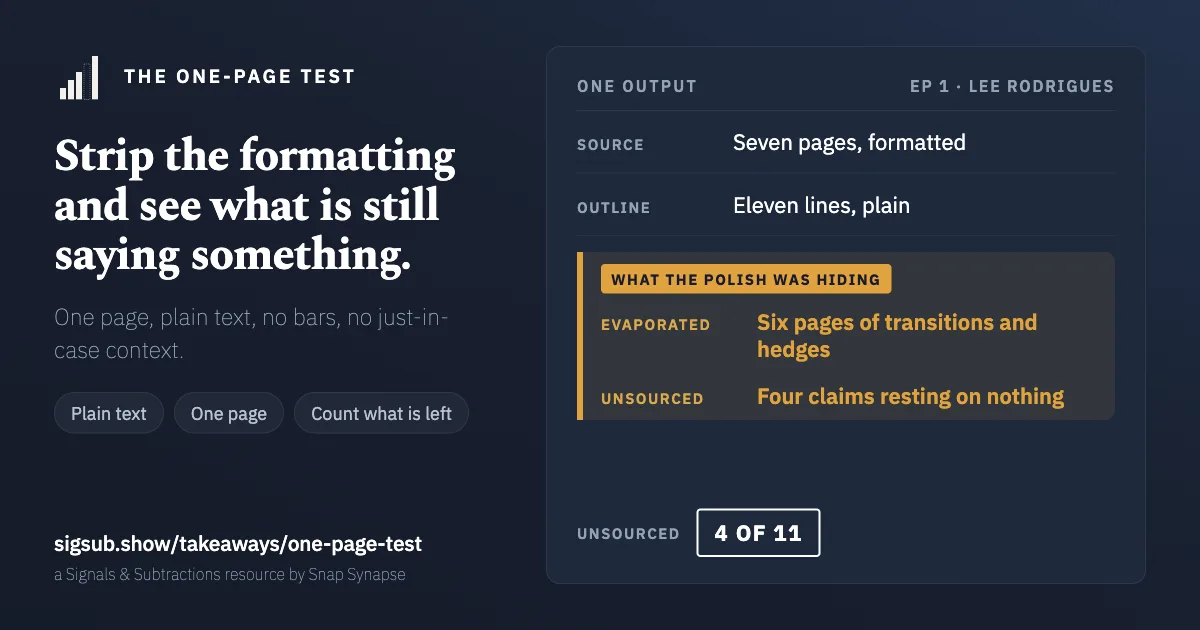
A model hands back seven pages. Headings, bullets, bold phrases, a summary box, a section called Next Steps. It looks finished, and that is the problem, because looking finished is the cheapest thing a model produces. Lee Rodrigues, on Episode 1:
And what I found is I was getting lost in the sauce with all the formatting and all these fields and everything. And you can't remember how much of this is me, how much did it come up with, how much relates to what I do.
The move
Lee's, from before there was a model to run it on:
And the big thing that changed for me was when I used to train designers, start with a one-page content outline. One page outline that clearly defines what we're talking about.
Applied to the seven pages:
said, hey, this is a beautiful seven-page document that I'm already lost in. Give me a one-page content outline. And going back to the basics without the polish and looking at this one page that we used to use back in the day made a whole lot of sense. That structure right there let me see where Claude's making stuff up.
And the strip list, which is the whole instruction:
So getting your AI message, getting the things you're working on down to a one page content outline, subtract the formatting, subtract the bars, subtract the just in case I need the context.
Sam's gloss on it in the same conversation is the sharpest statement of what the test is for:
The one page version, like the simplified version. Remove all flashy sparkles. What's the actual thing that we're doing here that you can't bluff?
The format, when Sam asked, was Lee's two words: "T X T or Mark Down". No document format, no styling, nothing a renderer can make look better than it is.
The count
The re-render is not the deliverable. The diff is. Three lists come out of the compression, and two numbers.
| Field | What goes in it | Who fills it |
|---|---|---|
source_length_words |
How long the original was | machine |
outline |
The one page, plain text, no formatting of any kind | machine |
kept |
The claims that survived compression | machine |
evaporated |
Text that carried no claim: transitions, hedges, restatement, the just-in-case context | machine |
unsourced |
Claims that survived but rest on nothing in the source material | machine, honestly |
verdict |
What you do with it | you |
evaporated is the number that lands. Seven pages that compress to eleven lines is not a summary, it is a measurement of how much of the document was formatting. unsourced is the risk: the claims that read as fact and came from nowhere in what we gave it. Lee's version of the second list is the reason the test exists: "It's finding things that were not a part of my content that it's bringing in from somewhere else, and I can just trim to subtract what isn't a part of it".
There is no worked example on this page. A filled test is one document of ours with its unsourced claims listed, and publishing it would say more about the document than the method.
The schema
{
  "schema": "one-page-test/v0.1",
  "source_length_words": 0,
  "outline": "plain text, no formatting",
  "kept": ["claims that survived compression"],
  "evaporated": ["text that carried no claim"],
  "unsourced": ["claims that survived but rest on nothing in the source"],
  "verdict": "unresolved"
}
Run it with any model
Nothing to install and no account. Paste the output and, if there was one, the source material it was supposed to come from. The model compresses and classifies; it may not add.
Run the One-Page Test on a document I am about to paste. The document was produced with AI assistance. I want to know what it is actually saying once the formatting is gone, and which of its claims rest on nothing.

If I also paste the source material the document was supposed to be built from, use it for step 4. If I do not, say so and treat every claim as unsourced except ones that are self-evidently definitional.

DO, IN ORDER
1. Count the words in the document and record source_length_words.
2. Re-render it as a one-page content outline in plain text. No headings styled as headings, no bold, no bullets deeper than one level, no tables, no summary box, no section that restates another section. If it does not fit on one page, it is not compressed enough; cut restatement first, then hedges, then transitions. Every line must be a claim, an instruction, or a fact.
3. kept: list every claim that survived, one per line, in the words the document used.
4. evaporated: list what you removed, grouped as transitions, hedges, restatement, or just-in-case context, with a count of each. Give a total in words.
5. unsourced: of the claims in kept, list every one that does not appear in, and cannot be derived from, the source material I gave you. If I gave you none, list them all and say why.

RULES YOU DO NOT BREAK
1. Do not add a claim that was not in the document. The outline may only be shorter than the source, never different from it.
2. Do not soften the unsourced list. A claim with no source stays on that list even if you believe it is true, even if it is common knowledge, even if it is obviously correct. Whether it is true is not the question; whether it came from somewhere is.
3. Do not rewrite for quality. Do not improve a sentence. Do not fix a fact. If the document is wrong, the outline is wrong in the same way and the unsourced list is where that shows.
4. Do not set the verdict. Leave it as "unresolved". What to do about the result is mine.
5. Do not tell me the document is good or bad, thorough or thin. Give me the outline and the three lists and stop.

OUTPUT
Valid JSON matching the schema one-page-test/v0.1 as published at https://sigsub.show/takeaways/one-page-test/, then the outline as plain text on its own, then one line: source words, outline lines, evaporated words, unsourced count.
What a machine may never do
It may compress, strip, classify, and name what disappeared. That is all arithmetic on text it was given.
It may never add a claim that was not in the source, and it may never soften the unsourced list. The moment a model decides a claim is fine because it happens to be true, the test has stopped measuring where the document came from and started measuring what the model believes, which is the thing we were checking in the first place.
The part that's not optional
Read the unsourced list before reading the outline. The outline will look reasonable; it always does, that is what compression does. The unsourced list is the part that tells us whether the reasonable-looking page can be sent to anyone.
Then, if the document is going out under our name, write the missing sources in or cut the claims. Lee's warning on the episode is what happens otherwise: "you end up sharing it with a client or something, and they say, Where did this come from?"