The Receipt Ledger
Is the AI cost in our budget a receipt or a guess?
Three bills, thirty minutes. Each cost comes out counted, billed, estimated or unknown, and a guess stops travelling as a fact.
For whoever has to defend the AI budget. You bring your three biggest AI bills·30min·any model·inventory
It ends in: counted, billed, estimated or unknown
Watch the three-minute walkthrough 2:55
A three-minute walkthrough: the question, the receipt that was thrown away, the fields, the verdict rule, keeping receipts automatically, and how to run the prompt in any model.
The decision it forces
Is the AI cost in our budget a receipt or a guess? Sooner or later someone asks what AI costs us for each thing it finishes: a resolved ticket, a reviewed contract, a drafted proposal. That's the number behind every decision to renew, scale up or cut. Most of us answer with the invoice total, or with a figure someone worked out once in a spreadsheet, and neither one gets labelled as what it is.
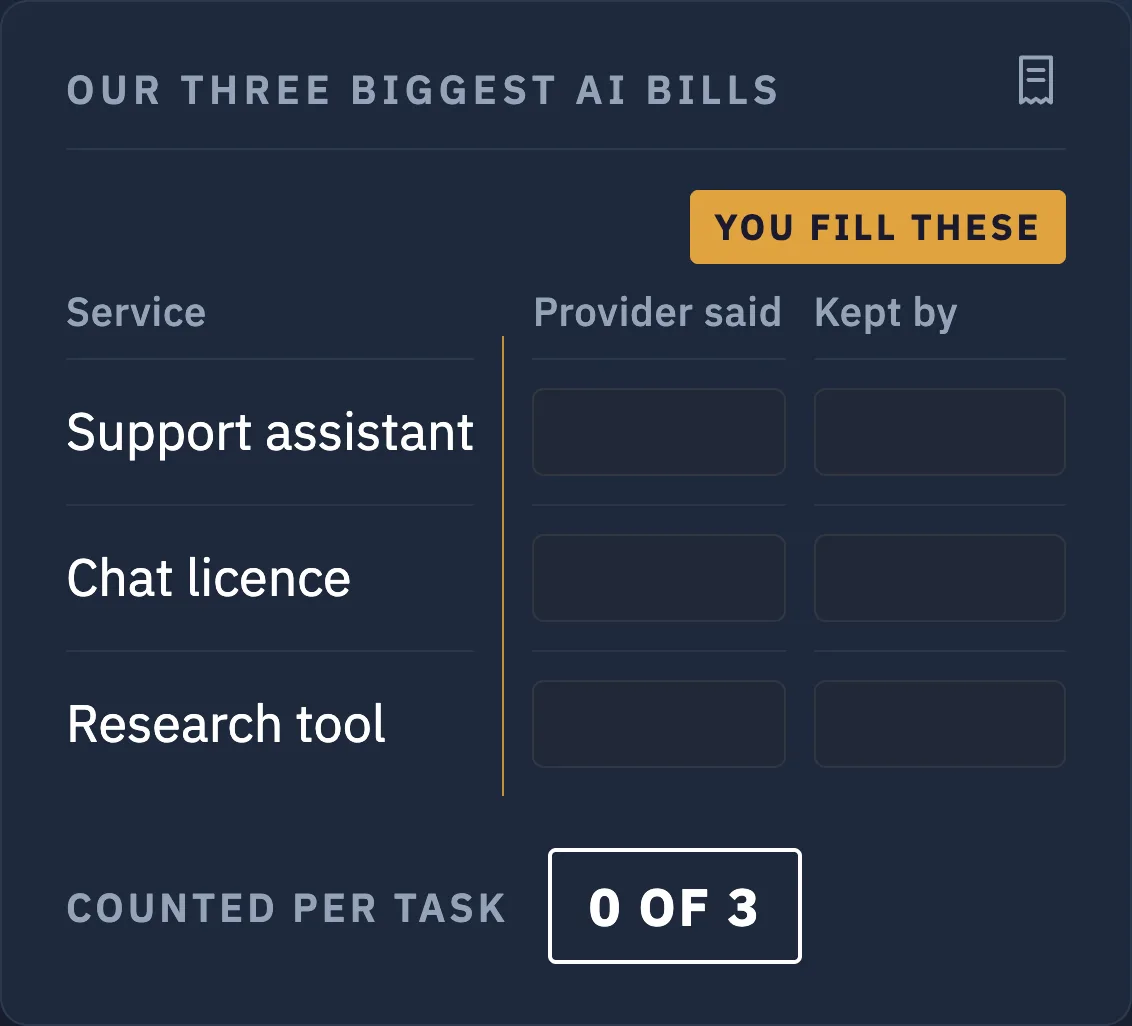
This ledger takes our three biggest AI bills and sorts each cost by where it came from:
- Counted. The provider's own figure, traceable to finished work.
- Billed. The provider's total, and nothing finer.
- Estimated. Our own arithmetic.
- Unknown. No figure at all.
Thirty minutes, and the next AI number we put in a budget or a board deck carries its label.
To run it, copy the prompt below into any model you already use.
The receipt was there, and we threw it away
Sam checked one of his own. In July, an AI research service he pays for had run 99 times. Each run came back with a small record from the provider of what that run used. His own setup threw 66 of those records away the moment the answer arrived.
The monthly totals were still on the provider's billing page. What was gone was which piece of work cost what, and the provider offers no way to ask for it again. Nothing was hidden. Keeping the record just wasn't anyone's job.
It was small money, which is why nobody noticed. That's the reason to check the bills that aren't small.
On Episode 20, Sam said why he stopped filling the gaps with his own price table:
An estimate can feel like a control, but it's not like the bill.
And what to give finance instead:
Giving them what the vendor actually states and marking the rest as unknown is probably a good ... idea because unknown is honest
The fields
Three questions per service, in plain words:
- What did the provider itself say this cost? Their figure, for a stated period. Not ours.
- Can the provider show usage one use at a time, and does anyone here keep it? An invoice is a total. A record per use is what lets a cost follow the work.
- What's one finished piece of work? If nobody can say, nothing can be divided by it.
One row per service. A machine can list the left half. Only we can fill the right.
| Column | What goes in it | Who fills it |
|---|---|---|
service |
The product, by the name on the bill | either |
usage_record |
The finest record the provider gives: each_use, totals_only, none (the provider says there isn't one) or unknown (nobody has asked) |
either |
kept_by |
The person, or the system with a named owner, who keeps that record on our side. A team is a blank, and so is "the vendor has it" | you |
provider_cost |
The provider's own figure and its period, copied as written ("$1,800, October"). Empty when they gave none | you |
our_estimate |
A figure we worked out, with how ("seats times list price"). Empty when we haven't | you |
task |
One finished piece of work for this service ("a resolved ticket"). Empty when nobody can say | you |
basis |
counted, billed, estimated or unknown, by the rule below |
derived |
There's no worked example on this page: a filled ledger names one organisation's suppliers and what it pays them.
The verdict rule
Each row gets one basis. Check in this order; the first that fits is the basis.
- 1st Counted The provider's figure is on file, usage arrives per use, someone named keeps it, and a finished task is defined Divide. This is the only cost per task we can defend
- 2nd Billed The provider's figure is on file, and one of the other three is missing Quote the total. Don't quote a cost per task yet
- 3rd Estimated No provider figure, only our own Say "estimated" every time it's used, and ask the provider for a record
- 4th Unknown No figure at all Leave it empty and say so
Absent isn't zero. A cost nobody stated stays empty. Zero goes in only when the provider's own record says zero.
An estimate never joins a receipt. A row with both is billed or counted, and the estimate sits beside the provider's figure for comparison. The ledger never adds the two and never totals money across rows; it counts rows.
A record nobody keeps is the cheapest fix on the page. A row whose provider gives a record, per use or in totals, with an empty kept_by is counted as unkept. The evidence is already being issued. Someone only has to be named to keep it.
Expect a first ledger to have no counted rows. That's what an honest one looks like.
Keeping the receipts automatically
Where AI use runs through code or agents, the per-use record can be kept as it arrives. Delegated.watch does that on your own machine, across the AI providers and tools it supports, with no sign-up, and never converts usage into money itself. It's Sam's own open-source project, its code is public on GitHub for anyone who wants to dig deeper into their own token usage, and nobody paid for this mention. The ledger doesn't need it: the bills and a spreadsheet fill every row.
Run it with any model
Service names and round figures are enough. Don't paste invoices, account numbers or keys.
You are helping me fill in a Receipt Ledger: one row per AI service my
organisation pays for, recording where each cost figure came from. You are an
interviewer and a clerk. You are not an estimator.

RULES, in order of importance
1. Never write a cost. provider_cost and our_estimate hold only figures I give
   you, copied as I gave them. Do not calculate one from usage, seat counts,
   list prices or anything you know about a provider's pricing, even if I ask
   you to.
2. Never write zero for something I did not state. If I have no figure, record
   null. Zero goes in only when I tell you the provider's own record says zero.
3. Never fill kept_by or task for me. If I answer kept_by with a team, a
   department or "the vendor", tell me that is a blank and ask once for a person
   or a system with a named owner. If I do not have one, record null.
4. Never add an estimate to a provider's figure, and never total money across
   rows. Count rows only.
5. Never tell me a service is expensive, cheap, worth it or wasteful. This
   ledger records where the numbers came from, not whether they are good.
6. Do not ask for invoices, account numbers, API keys or credentials. Service
   names and figures I choose to share are enough.

INTERVIEW ME, one service at a time, three questions at a time at most.

Start by asking for organisation_scope and my three biggest AI bills. I may add
more afterwards. Never name a service I did not.

For each row ask, in this order:
service: the product, by the name on the bill.
usage_record: what is the finest record of usage the provider gives us? each_use
if every use returns or logs one, totals_only if there is only an invoice or a
billing page, none if the provider has said there is no record, unknown if
nobody has asked. If I say "none", ask whether the provider told us that or we
are assuming; an assumption is unknown.
kept_by: who or what on our side keeps that record once it arrives?
provider_cost: what did the provider itself say this cost, and for what period?
Record both in one string.
our_estimate: have we worked out a figure ourselves, and how? Record both in one
string.
task: what is one finished piece of work for this service?

Then set basis yourself, checking in this order and stopping at the first that
fits:
counted: provider_cost is filled, usage_record is each_use, kept_by is filled
and task is filled.
billed: provider_cost is filled.
estimated: our_estimate is filled.
unknown: neither figure is filled.

OUTPUT
Valid JSON matching the schema receipt-ledger/v0.1 as published at
https://sigsub.show/takeaways/receipt-ledger/#the-answer-format. If you can't
read that page, use these keys, in this order: schema, organisation_scope;
services, a list, each with service, usage_record, kept_by, provider_cost,
our_estimate, task and basis; totals, with rows, counted, billed, estimated,
unknown and unkept. unkept counts rows where usage_record is each_use or
totals_only and kept_by is null. Then the ledger as a table with the empty cells
visibly empty rather than filled with dashes, zeros or placeholders. Then, for
each row, one line I could say in a meeting: the service, its basis, and the one
thing missing before it could be counted. End with two plain sentences, the
count of rows that are counted and then the count that are unkept, and nothing
after them.
What to check in the answer
A model may list the services, sort our answers into columns and apply the rule. It may never supply a number, a keeper or a task: check every figure against what was typed in, check that nothing empty became a zero, and check that no line adds the rows into one total.
The part that's not optional
Label the next number. Wherever an AI cost appears in a budget, a renewal memo or a board deck this quarter, put its basis beside it in one word. An estimate that's called an estimate is fine. One that isn't is the problem this page exists for.
Then, this week, name a keeper for every unkept row. And for every row that's estimated or unknown, ask the provider in writing what record it can give. "We don't offer that" is an answer, and it belongs on the table at renewal, which is where The Renewal Card picks up.
For builders
The answer format
{
  "schema": "receipt-ledger/v0.1",
  "organisation_scope": "",
  "services": [
    {
      "service": "",
      "usage_record": "unknown",
      "kept_by": null,
      "provider_cost": null,
      "our_estimate": null,
      "task": null,
      "basis": "unknown"
    }
  ],
  "totals": {
    "rows": 0,
    "counted": 0,
    "billed": 0,
    "estimated": 0,
    "unknown": 0,
    "unkept": 0
  }
}
usage_record is one of each_use, totals_only, none or unknown. basis is one of counted, billed, estimated or unknown. kept_by, provider_cost, our_estimate and task are null rather than empty strings when nobody can fill them. The two cost fields are strings, not numbers: each carries the figure as stated, with its currency and its period or its working, so it can't be summed by accident. unkept counts rows where usage_record is each_use or totals_only and kept_by is null; the other totals count rows by basis.
Got an answer back from the prompt? Read it against this schema. It runs in your browser and sends nothing.
Report back
Ran this? Tell us what happened. What broke and what you changed are the useful parts, because that's how the next version gets better.
Or write to hey@sigsub.show with Takeaway: receipt-ledger as the subject. It's a plain email: no form, no account, nothing tracked. Nothing you send appears here unless you say yes, and you choose how you're named.
Rather talk it through in public? Comment on the Sunday issue on Substack, the same issue on LinkedIn or the episode on YouTube. Those threads live on their platforms, under their rules; nothing from them runs on this page.
Keep the next choice in view
One signal, one subtraction and one analogy every Sunday. Five minutes, no video required.
Optional. Free on Substack, no account needed. Already on LinkedIn? Subscribe there.