The newsletter · Sunday 15 November 2026
By the Pound
At the buffet, the prime rib costs the same as the salad. Robert Alvarez, PhD says AI is heading for the scale, and most of us can't say what one task costs.

One signal 📡 One subtraction ➖ One analogy 🍽️
Created by Sam Rogers of Snap Synapse | Episode 20 with guest Robert Alvarez, PhD | The Sunday newsletter of the weekly show at sigsub.show
🍽️ Analogy of the Week: By the Pound
Picture the all-you-can-eat buffet. One price at the door, and nobody counts plates. The prime rib costs the same as the salad, so of course it lands on most every plate. Now picture the food bar at Whole Foods: the steam trays and serving spoons aren't different, but at the register the box goes on a scale, and we pay by the pound. I first met this weighted-food idea at a comida a quilo in Brazil, where whole restaurants run on it. Nobody changed the food. Everybody changes how they fill their plate.
Most of us use AI at the buffet: a flat monthly seat, and the smartest model on every request, because the bill costs the same as the small one. Robert Alvarez, PhD, AI Architect at Everpure, says the scale is coming: "there will come a day when you no longer pay for a monthly fee. You now pay per token. And that's when you're gonna realize how much AI you're really using." For enterprises and API users, that day is already here.
His cure for the prime rib habit: "stop using the most intelligent model just because it is the most intelligent model." For the shell commands he still looks up after half a life on Linux, "Haiku is more than enough."
At the buffet, the prime rib costs the same as the salad. At the scale, we find out what we've been eating.
📡 Signal: The receipt is the only witness
Robert's signal was that every enterprise needs its own benchmark: a list of the tasks that matter, each with a known pass, and "a bunch of different models" pitted against it to learn what each task needs and what it costs. That's how we'd know which plates deserve the prime rib.
There's a catch, and I found it in my own records in July. My agents researched calls to one AI service, and each call came back with the provider's own record of what it used. My setup threw 2/3rds of them away before anyone saw them. The monthly totals survived on the billing page. Which piece of work cost what didn't, and that record "is the only receipt that will ever be."
Last Sunday showed what else receipts are for. Less than a week into my billing cycle, Anthropic's spend alert fired, and only the per-key view said where: one API key, nearly 72 million tokens in a single day on a key that usually does around 1000x less than that. Lazarus malware I'd cleaned out of a repository six months ago came back from the dead...on an unsecured side branch that published to a testing instance. Whoever ran up the tab took Robert's advice too because most of it went to Haiku.
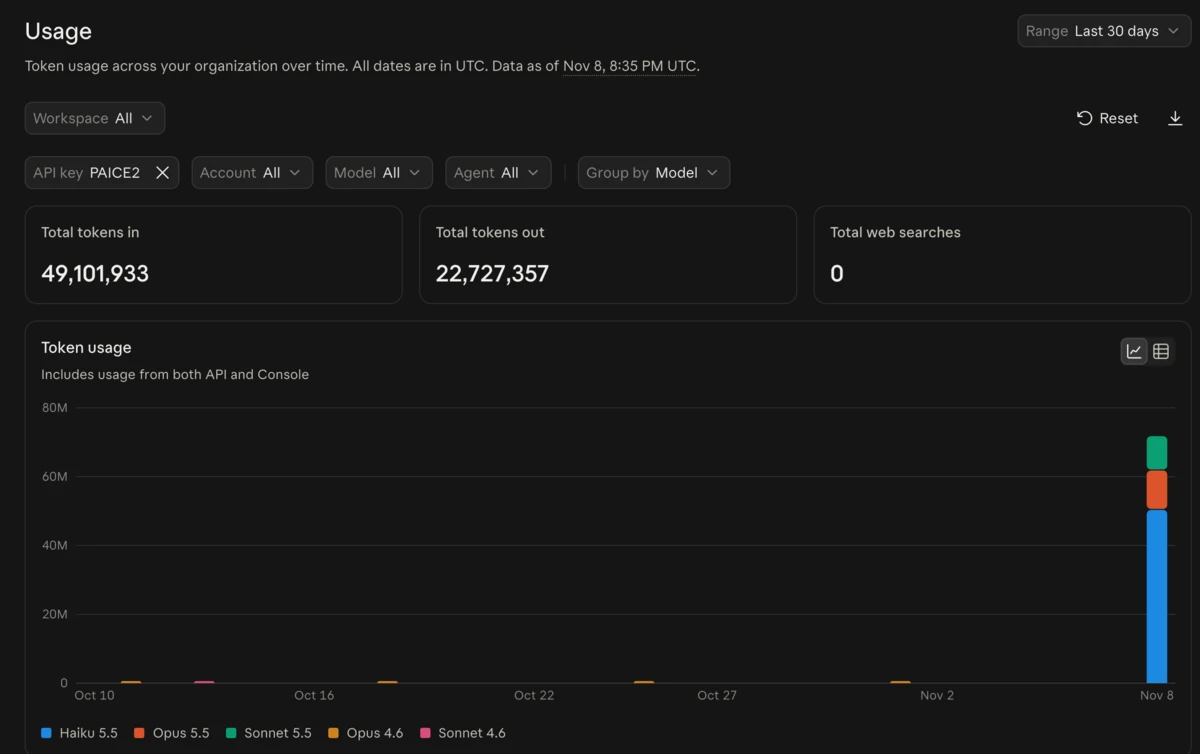
A benchmark tells us which model a task deserves. Only the receipt tells us what it cost, and who ate it.
➖ Subtraction: Estimating the costs nobody reported
When I started adding up my own AI spend, subscriptions plus my API keys billed a different way, I filled the gaps with my own math: tokens times a price table. Then, in the same week, one call's own receipt came back at four tenths of a cent, and another (at the same 579 tokens) said it cost $0.00. Robert's guess: "a rounding error." Mine: "An estimate can feel like a control, but it's not like the bill."
So I've subtracted it. I keep only the costs the provider reports, and everything else is marked unknown. Filling those gaps with my own price table was (in a term I learned from Robert) "p-hacking" my own budget. When finance asks, they get what the vendor actually states and an honest unknown, because unknown is honest.
Robert's suggestion for what comes after: sort the failures that might still be billed into buckets. 2% of the bill? Might be a reasonable deviation. If it turns out "I'm basically paying half of my bill to some things that I just don't know," then the problem is probably in our own pipeline.
It revises my own advice, too: Intelligence: Rent or Own? started from projected API spend. A projection still helps decide what to do next. It just isn't a record of what anything cost.
A labeled unknown can be fixed. An unlabeled estimate gets defended.
▶️ Watch, read, or listen

The full conversation with Robert, with the transcript and every format, is at sigsub.show/episodes/ep-020.
Jump to a segment: every enterprise needs its own benchmark · what the model is given to read · no itemized receipt · one dashboard · the smartest model by default · intern, generalist, PhD · the Kanban board · costs the provider didn't report · sorting the failures
🧭 Take It to Work
This week's takeaway, The Receipt Ledger, starts with our three biggest AI bills and sorts every cost by where it came from: counted per finished task, billed as a total, estimated by us, or unknown. Expect no counted rows the first time. That's what an honest one looks like.
In Key Under the Mat, Tim McAllister warned that long-lived API keys sit untouched for years because they're "such a pain in the butt to change." I swept mine after that episode and missed the one that proved him right. A key that bills by the token is a tab anyone holding it can run up, so every key gets its own row in the ledger, a scope, an end date, and a spend limit for when we can't find it fast enough.
Pick one AI task your team runs every week. Can you say what it costs, and whether a cheaper model would do? Send me your answer, or bring it to the show.
The buffet won't last forever. Better to learn how to fill a plate before the scale shows up.
Good luck,
Sam Rogers Buying AI by the Pound

New here? Subscribe at sigsub.show and the next episode lands in your inbox.
Somebody on your team signs off on the AI bill without knowing what's on the plate. Forward this to them, with thanks.
Related reading:
- Intelligence: Rent or Own? (054): stop paying frontier rent on steady work. This week, the same habit one task at a time, and a correction to its projected-spend math.
- Confidence & Calibration (023): reward calibration, not confidence. An unlabeled estimate is confidence without calibration.
- Better Boiled Water (073): vendors folded AI into the seats and raised the price with no opt-in. The buffet's price was already moving.
- Key Under the Mat (075): effort used to be a lock, and long-lived keys were the spare under the mat. This week, one of mine got found.
- Every episode's takeaway: sigsub.show/takeaways.
This week's guest: Robert Alvarez, PhD. His articles are on his Everpure author page.
Get the next one
Free weekly newsletter on Substack. No account needed. Already on LinkedIn? Subscribe there.
One signal, one subtraction, one analogy, every Sunday. Every issue, back to 001.