The newsletter · Sunday 11 October 2026
One Shorter Leg
AI lengthened two legs of every decision overnight. The one that keeps us standing didn't grow at all.

One signal 📡 One subtraction ➖ One analogy ☕
Created by Sam Rogers of Snap Synapse | Episode 15 with guest Michelle Florendo | Issue 72 of the Sunday newsletter
☕ Analogy of the Week: One Shorter Leg
Every café has one: the table that wobbles every time we set a cup down. Lean down to look, and there it is, a folded napkin wedged under one foot.
My guest this week, decision engineer Michelle Florendo, teaches a frame from Professor Ron Howard, one of the founders of decision analysis (no, not the other one): every decision stands on objectives, options, and information. "They're like three legs of a stool," and if you haven't examined all three, "your decision or your stool topples over."
Now look at what AI did to that stool. It lengthened two legs overnight, options and information. The one that holds what we actually want is exactly as long as it was last year. One short leg, and the whole decision wobbles.
And when it does, our reflex is more research, more options, another analysis: lengthening the legs that were already long.
You can't level a stool by lengthening the legs that are already long.
📡 Signal: Tools build the long legs longer
Look at what AI tools keep shipping. Deep research modes in ChatGPT and Gemini. "Give me ten options." Briefs, comparisons, scenario tables, all with citations. Every one of them lengthens the options leg or the information leg. I don't know about you, but I can't name one whose headline feature is helping us say what we actually want.
That isn't an oversight. Options and information are easy to demo and easy to measure. Objectives are neither. As a founder, I've struggled to communicate this more times than I can count, and I've learned the hard way why the market keeps building the legs it can sell.
On the show I put it this way: "AI has made the analysis part really cheap." But "nobody's objectives necessarily arrive any faster." For years the expensive part of a decision was gathering the inputs, so a team that couldn't decide could reasonably say it was still gathering. That excuse is hereby expired. When the brief takes a minute, a decision that's still stalled a month later isn't waiting on data.
➖ Subtraction: Good = Rational
The fastest way to stretch the long legs further is to ask a model to decide for us. It'll list the pros and cons, weigh them, and hand back the rational choice. But just because it's the most rational choice to an AI doesn't mean that it's the best choice for a human.
Michelle hears the same thing from very cerebral clients: I need to be rational about this. Her answer is a question. "Can I call you out on this assumption you're making that good decisions must be purely rational?" Half of what we want only shows up as a feeling: a tightness, a reluctance, a fear we haven't named. Her rule is that "emotions point to needs." A model can't feel which option makes our stomach drop. That feeling is information only we can supply.
So subtract the request for a recommendation, and run the short-leg test instead. Can you state what you want from this decision in one sentence? If not, that's the short leg, and no amount of data will level it.
▶️ Watch, read, or listen
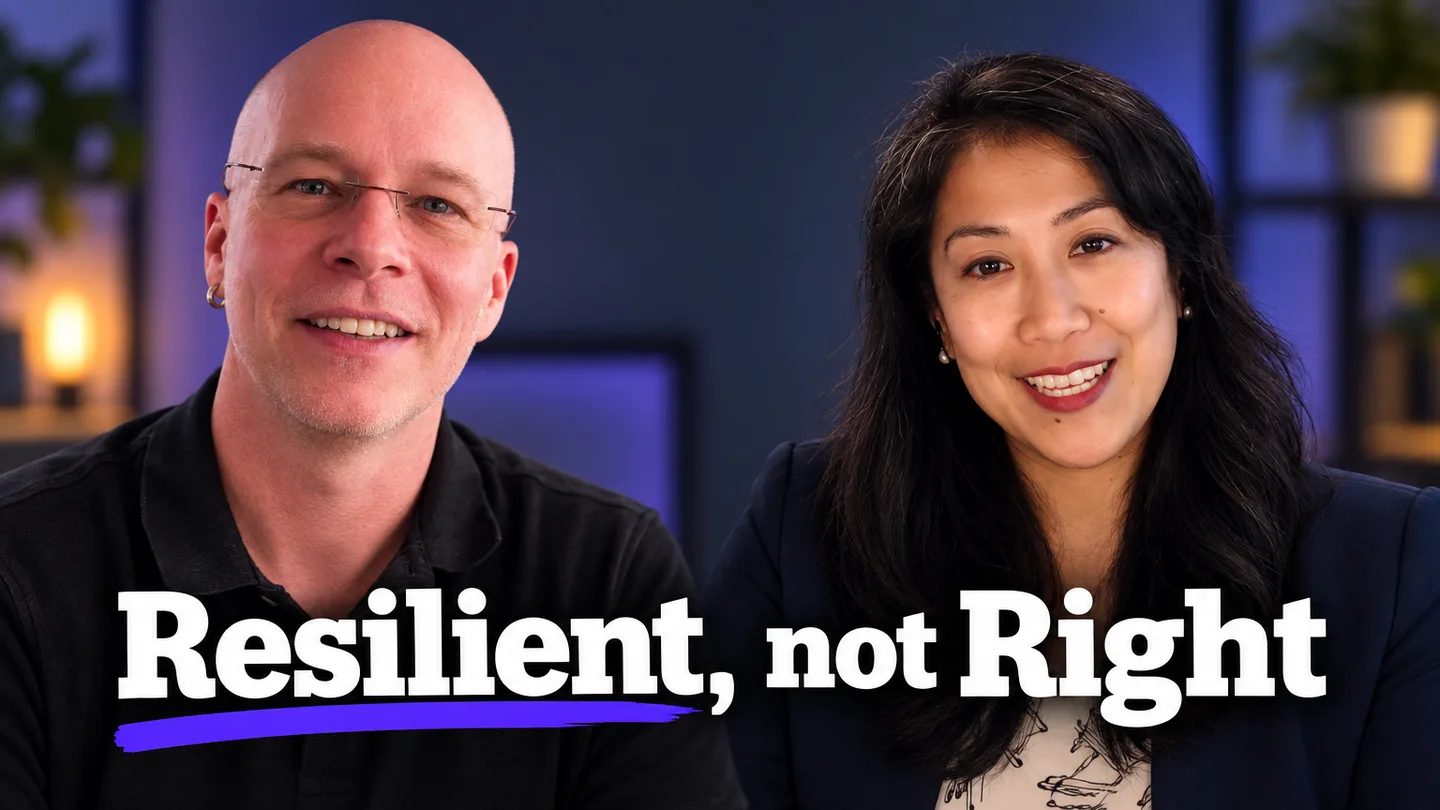
The full conversation with Michelle, with the transcript and every format, is at sigsub.show/episodes/ep-015.
Jump to a segment: three legs of a stool · analysis got cheap · fear of something better · resilient, not right · not a rational advisor
🧭 Take It to Work
The "Resilient, Not Right" line is the one I kept turning over all week. Right means we got what we wanted, or predicted the future, and more and more that's luck. Resilient means the process holds when the outcome doesn't go our way. We can't control the outcome. We can control whether every leg is the same length before we sit down.
This week's takeaway, The Concern Column, turns that into an interview any model can run: objectives first, then what attracts and what concerns us about each option, asked and never guessed.
Which decision are you about to put your weight on, and what do you actually want from it? Send me your answer, or bring it to the show.
Next time a decision wobbles, check the legs before calling for more data.
Good luck,
Sam Rogers Leveler of Wobbles

New here? Subscribe at sigsub.show and the next episode lands in your inbox.
You know at least one person whose important decision is stuck in research right now. They'd probably appreciate it if you forward this to them.
Related reading:
- Skills Are Bets, Not Gates (042): skills improve the odds and never guarantee the outcome. This issue applies the same split to decisions: judge the process, not the result.
- Talking to AI Like It's a Computer (016): treating AI as a vending machine or an oracle. A purely rational advisor is the oracle with a spreadsheet.
- No Wrong Answers (067): set the bar before you see the output. Objectives first is the same move, made before the options arrive.
- Every episode's takeaway: sigsub.show/takeaways.
This week's guest: Michelle Florendo. Her Substack, Decision Fluency, is where she asked listeners to go, and her podcast Ask a Decision Engineer is back for its seventh season soon! Now's a great time to follow, here's her trailer.
Get the next one
Free weekly newsletter on Substack. No account needed. Already on LinkedIn? Subscribe there.
One signal, one subtraction, one analogy, every Sunday. Every issue, back to 001.