Episode 15 · 2026-10-09
You Have Data. Why Can't You Decide?
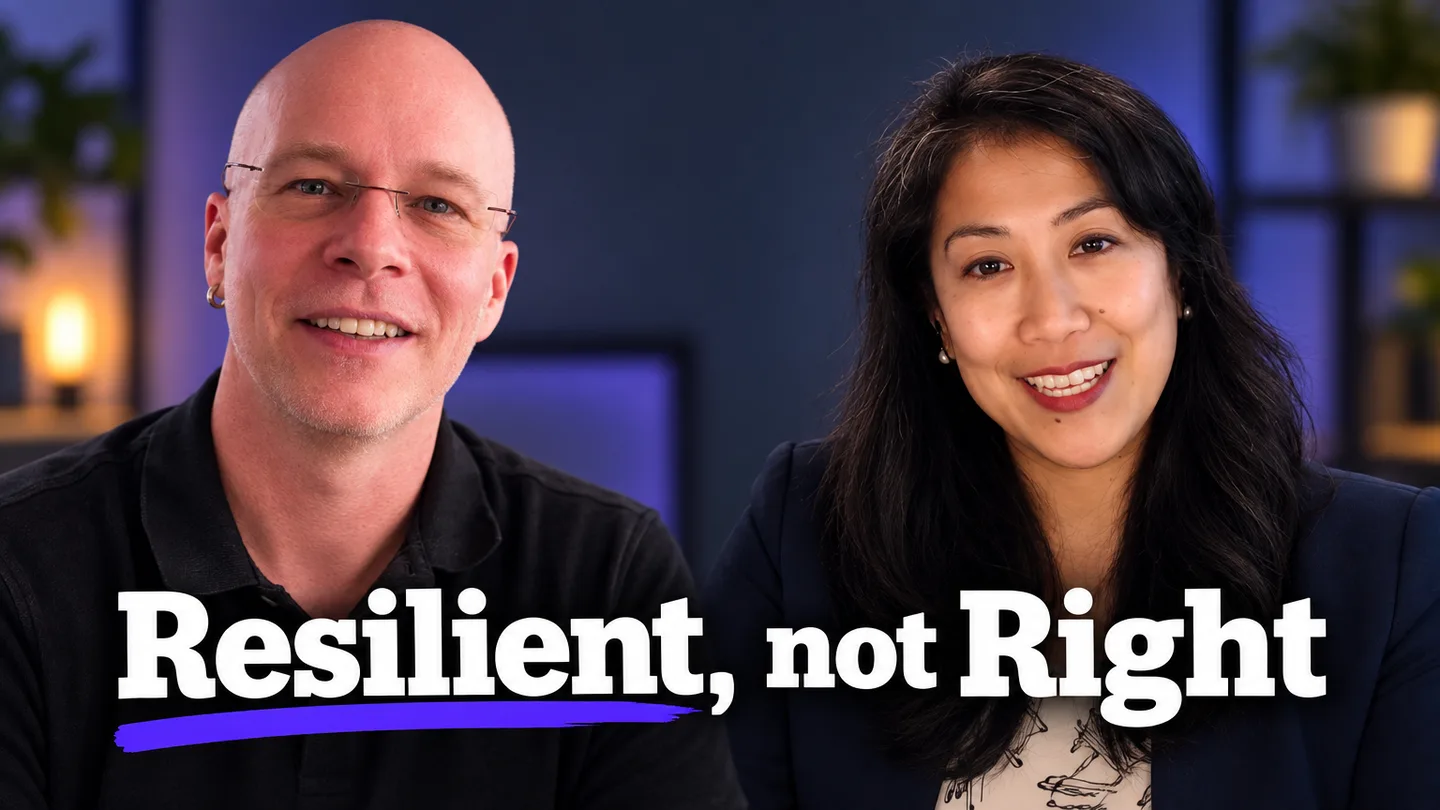
Decision engineer Michelle Florendo on why more data hasn't made deciding any easier. As AI takes over the doing, the deciding matters more, and the hard part was never the options or the information: it's knowing what you want, and counting the data that never shows up on a dashboard, like fear, a gut sense, or a feeling that something is off. Sam's signal is that analysis got cheap while objectives didn't arrive any faster. Michelle's subtraction is the belief that good decisions must be purely rational, because it's more important to be resilient than to be right.
Host Sam Rogers · guest Michelle Florendo · 27 min
A choice this episode can help with
Which decision are you sitting on, and what do you actually want from it before anyone hands you the pros and cons?
Run it on your own work: The Concern Column, one page, any model.
Premieres Friday 9 October 2026 on YouTube and in podcast apps. Open it on YouTube to set a reminder.
The signals
- Michelle: As we offload the doing, the deciding matters more. "As we're offloading the doing, the deciding becomes more important," and she's watching clients, organizations and individuals run into exactly that. A senior tech leader she coaches noticed that the way he, his team and the teams around him made decisions had to change: how they communicate a decision, when they make it, at what cadence. To her those are the basics of decision skill, like how you frame a decision, when it expires, and keeping decision records so a fast-moving team can look back at what the process was and iterate on it. Her frame comes from Professor Ron Howard, a pioneer of decision analysis: every decision has three parts, like the legs of a stool, and if you skip one it topples. Objectives are the compass, what you want to see in the outcome, and people dive into decisions without ever saying what they're trying to achieve. Options are the familiar leg, where the mistake is falling into a binary and not taking even a little time to look beyond the obvious. Information is the leg that gives people the most feelings: what's relevant, what would actually change the decision, and what to do about what you don't know, since "waiting for certainty is a decision in itself." The trap she sees is assuming relevant information must be rational and easily measured, when people also need to read what's happening emotionally for everyone involved, and the bodily, gut-instinct inputs that need decoding before they can be folded in.
- Sam: Analysis got cheap, and objectives didn't get faster. "AI has made the analysis part really cheap," so much so that deciding is basically the real job now. Options and information, two legs of Michelle's stool, are nearly free, "but nobody's objectives necessarily arrive any faster." That's what shaped the episode's takeaway, a successor to the pros-and-cons list, which Michelle points out is more than two hundred years old: "We can upgrade our tools for decision making." The Concern Column has a model draw out the information that comes from inside, not just what usually makes it into the analysis, and gets clearer about objectives as it goes. Sam ran it on a real decision about his own business that morning. Michelle's read on it: part of improving a decision process is "making the implicit stuff that's happening inside of us more explicit," and AI or pen and paper can both help, as can simply giving people permission to sit with their decision process, which most don't do enough.
The subtractions
- Michelle: Subtract the idea that good decisions must be purely rational. She works with a lot of cerebral people in tech who tell her they need to be rational about a decision, and her answer is a question: "can I call you out on like this assumption you're making that like good decisions must be purely rational?" Ignore the other sources of data and key pieces go missing. Risk often surfaces as an emotion, so name it: fear of a business no longer being viable is different from fear of being embarrassed, and both are data worth decoding. Behind indecision she sees patterns. Some people won't decide because something bad might happen and they'd be the one who chose it; emotions point to needs, so the move is to weigh that need against the bigger objectives and let go of the less important one. High achievers and engineers have the opposite fear, not FOMO but FOSB, fear of something better, which keeps leaders stuck on finding the best answer when the team needs to move and learn. And she separates the quality of a decision from the quality of its outcome, what Annie Duke's Thinking in Bets calls resulting: drive drunk and get home safely, and it was still a bad decision. Her line to keep: "it's more important to be resilient than to be right," where right means getting what you wanted or predicting the future, which is increasingly luck. The process and your resilience are what you control.
- Sam: Stop using AI simply as a rational advisor. "Just because it's the most rational choice doesn't mean that it's the best choice." In a meeting last week he watched people ask AI for the pros and cons, which automates part of the useful information and only half of where good decisions come from. A model doesn't have access to the physical feelings Michelle described. Sabino Marquez made the same point on [Episode 4](/episodes/ep-004/): safety is a feeling in the body, not something you get from SOC 2 and compliance alone, and the pull or aversion that says this is unsafe often shows up there first. A concern that isn't coming from a rational place is still a valid source of information, and AI can't have it for you. Michelle's button on it: "good decisions need to make sense but also feel right," and "you can't calculate your way to trust."
About this episode
The thread through the episode is the one Sam opened with: we have more information than ever, and the decision still sits there. What's missing isn't data. It's the objectives nobody wrote down and the concerns nobody counted, and Michelle's case is that both are learnable skills, which she calls decision fluency.
Markus Bernhardt sent in a question from the livestream: how do you get people to frame the question before they see any options? Michelle's answer is that framing comes before all three legs. It's the fourth part of Decision Quality, the red book on her shelf that's popular with the Society of Decision Professionals, and leading with options gives you a narrow frame. Sam added the framing assumption he sees most: that a good process will insulate you from a bad outcome, which rolls decision quality and outcome quality into one thing.
One thing to do this week: pick one decision you're sitting on. Before you ask anybody, or any disembodied agent, for the pros and cons, write down what you actually want from it. Then for each option, write down what concerns you and where you feel it, and whether that points to something you want that isn't on your list yet. That's the part no amount of data will give you.
Links from the episode:
- Decision Fluency: Michelle's Substack, the one place she asked listeners to go
- Ask a Decision Engineer: her podcast, back for its seventh season this month
- Powered by Decisions: her practice
- The Concern Column: the episode's takeaway, built on her Pro-Con List With A Twist
- Earlier episodes Sam called back to: Episode 14 with Limited Edition Jonathan for the AI deep end, Episode 12 with Omar Ladak on objectives, Episode 7 with Douglas Hubbard on information, and Episode 4 with Sabino Marquez on safety as a feeling
Books Michelle pulled off her shelf: Decision Quality, and Annie Duke's Thinking in Bets. As an Amazon Associate, Snap Synapse earns from qualifying purchases made through the book links on this page.
Want to bring your own signal and subtraction? Find yours.
Transcript
Read the conversation
Michelle Florendo: I see a lot of people say, I need to make a good decision here, I need to be rational about it. And I'm like Okay, and can I call you out on this assumption you're making that good decisions must be purely rational?
Sam Rogers: Welcome to Signals and Subtractions. I'm your host, Sam Rogers. You have data, so why can't you decide? That's the question of the day. Most of us have more information than we've ever had: reports and dashboards and a model that will hand us 10 options and a cited brief in a minute or less now. So still the decision sits there. Or it gets made and then remade and then second guessed? So today I have brought in someone whose whole job is helping facilitate the deciding part. Michelle Florendo is a decision engineer and facilitator. She's the founder of Powered by Decisions, and she's trained in decision science at Stanford. She's coached leaders at some of the biggest companies you know. She's also the host of her own podcast, Ask a Decision Engineer, back for its seventh season later this month. Very excited to have you here, Michelle. Welcome.
Michelle Florendo: I'm excited to be here and excited for this conversation.
Put it to work
Pick one decision you're stuck on. What concerns you about each option, and what does that concern say you actually want?
The takeaway
The method from this episode, handed over whole: one page with its copy-paste prompt and JSON schema. Every takeaway.