The Concern Column
The column a pros-and-cons list leaves out.
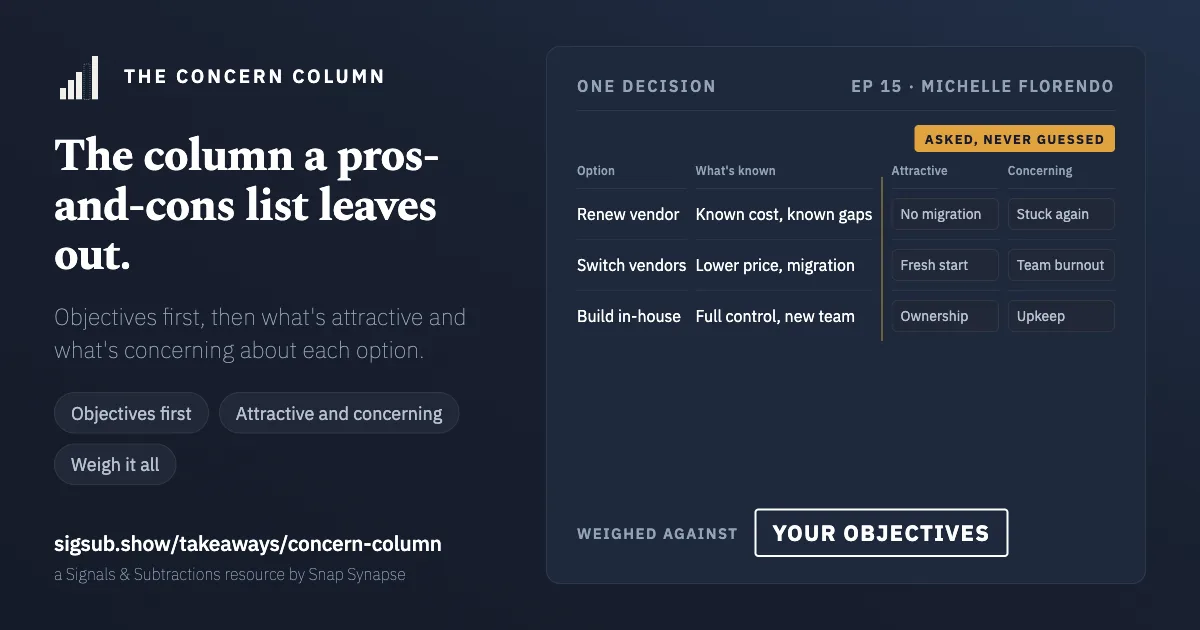
Objectives first, then what's attractive and what's concerning about each option, so the decision rests on everything that matters.
The decision it forces
Before a model helps you weigh your options, has it heard what you want, and what about each option concerns you?
Most of us skip both. We paste the situation into a chat window, ask for the pros and cons, and get back a tidy, balanced list in seconds. It looks rigorous, and the model is genuinely good at this part. The trouble is what we handed it: the rational half of the information, and none of the rest.
The argument
Good decisions aren't born of rational thinking alone. What concerns you about an option is information too, often the most important information in the room, and it's the one kind a model can't look up. As Sabino Marquez put it on Episode 4, "safety is a feeling in the body." Only you can report it. (His episode also produced Human in the Loop, Honestly, for the person who's supposed to be able to say no.)
So the move isn't to stop using AI to decide. It's to change what we give it. Have it ask what you want before anything else. Let it help with what's known about each option, where it's genuinely useful. Then have it ask you, option by option, what's attractive and what's concerning, and weigh all of it, concerns included, against the objectives you named. When it suggests a direction, it shows which of your objectives and concerns that direction rests on, so you can see whether it actually heard you.
The structure is Michelle Florendo's Pro-Con List With A Twist: instead of pros and cons, a column for each option, asking what's attractive about it and what's concerning, then looking for themes. She teaches the full method in her Decision Toolkit for Coaches and Counselors, and she's been answering questions like these for six seasons on her podcast, Ask a Decision Engineer.
The fields
| Field | What it holds | Who fills it |
|---|---|---|
| Objectives | What you actually want from this decision, in your words | You |
| Options | The choices on the table, including ones you add | You; the AI may suggest more |
| Information | What's known about each option, and what isn't | The AI may draft; you check it |
| Attractive | What draws you to each option | You |
| Concerning | What concerns you about each option, and where you feel it: head, heart, or body | You; the AI asks, never guesses |
| Themes | Patterns across your answers | The AI groups them, in your words |
| Weighing | How each option serves your objectives, concerns counted | The AI drafts; it names what each point rests on |
The rule
Your concerns are asked for, never supplied. If the model invents a concern for you, or quietly drops one you named, the weighing is built on the wrong information. And any direction it suggests has to name the objectives and concerns it rests on. If it can't, it hasn't heard you yet, so go back to the questions.
The schema
{
  "schema": "concern-column/v0.1",
  "decision": "string, one sentence",
  "objectives": [
    "string, the user's own words"
  ],
  "options": [
    {
      "name": "string",
      "suggested_by": "user | ai",
      "information": "string, drafted by the AI and checked by the user",
      "information_gaps": "string, what isn't known yet",
      "attractive": "string, the user's words",
      "concerning": "string, the user's words, asked for and never invented",
      "felt_in": "head | heart | body | unsure"
    }
  ],
  "themes": [
    "string, grouped from the user's own answers"
  ],
  "weighing": {
    "leaning": "string, an option name, or null if the user asked for none",
    "rests_on_objectives": [
      "string"
    ],
    "rests_on_concerns": [
      "string"
    ],
    "what_would_change_it": "string"
  }
}
Run it with any model
You are going to help me make a decision. Before you weigh anything, interview me.
Do not give me a pros-and-cons list. Ask one question at a time, and wait for my answer each time.

1. Ask me to state the decision in one sentence.
2. Ask what I actually want from it: my objectives, in my own words.
3. If I name an option instead of an objective, ask what that option would get me.
4. Ask me to list the options. You may suggest at most two more, labeled as your suggestions.
5. For each option, draft what's known about it and what isn't. Mark it as your draft and ask me to correct it.
6. For each option, ask me what's attractive about it. Use my words, not yours.
7. For each option, ask me what's concerning about it, and whether I feel it in my head, heart, or body.
8. Never invent a concern for me or finish my sentence. If I say I don't know, leave it blank and move on.

Then help me decide:
- show me my objectives, and a table of the options with my attractive and concerning answers
- name the themes you see across my answers, quoted in my own words
- weigh each option against my objectives, counting my concerns as information, not noise
- if I ask which way to lean, say so, and name the objectives and concerns it rests on
- tell me what would change your view

Then fill in the concern-column/v0.1 JSON.
What a machine may never do
Invent a concern you didn't state, finish one you've started, or soften one you've named. Drop a concern from the weighing because it doesn't fit. Suggest a direction without naming the objectives and concerns it rests on.
The part that's not optional
Objectives first. If you can't say what you want, no weighing of options, however good, will tell you which one gets you there. This page carries no worked example, because the conversation behind it hadn't happened yet when it was built, and a schematic one would only be ours.