Two Decisions and an Owner
Should AI do this, how much do we check, who owns it?
Six questions for one AI-assisted decision. The tool's opinion of itself answers none of them.
You bring one AI-assisted decision·10min·any model·card
It ends in: act, do it without AI, resize the check, or not ready
Watch the two-minute walkthrough 2:22
A two-minute walkthrough: the three questions, the ditch on either side of each decision, the fields and the verdict rule, and how to run the prompt in any model.
The decision it forces
Should AI do this, how much do we check, who owns it? Every AI-assisted piece of work reaches a moment where somebody acts on it. The draft goes to the client, the summary goes to the board, the screen sorts the candidates. Most teams treat that moment as one question, "is it good?", and answer it by feel.
It's three questions, and the order matters. Should AI be doing this at all? If so, how much do we check before acting? And whose name is on the result? Two decisions and an owner. Each has two parts, which makes six fields, and every one of them is a field a person fills.
To run it, copy the prompt below into any model you already use.
Its own say-so doesn't count
Each of the two decisions has a ditch on either side of the road.
Should AI do this? On one side is vanity use: we can use AI for it, so we do, and the result is faster and shinier and no better. On the other is avoidance: we don't trust it, so we redo the work by hand, or never try. Loyalty to the new tool and loyalty to the old one fail the same way, by skipping the only question that matters, which is whether the result is better.
How much do we check? On one side is overtrust: the output looks fluent, so it ships. On the other is verification overload: we check everything to the same depth, burn out, and start making the errors the checking was meant to catch. The fix for both is the same. Let the stakes set the checking.
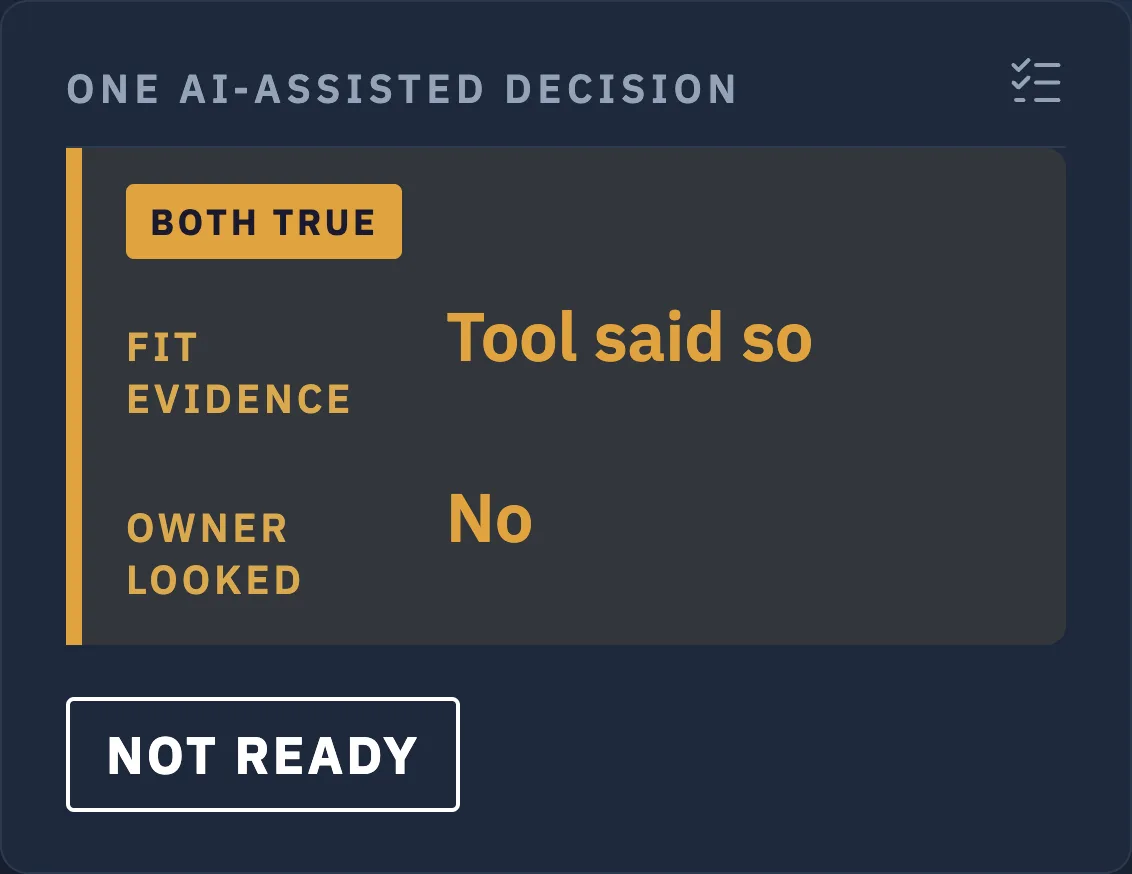
The first trap sits under both decisions. Ask a tool how well it does a task and it'll tell you, confidently. That isn't evidence. A status light that says live while nothing is going out is a tool vouching for itself, and so is a model rating its own accuracy. Fit means evidence that this tool does this task well, here, now, from somewhere other than the tool.
The fields
One decision per card, six fields, filled in order; the first one that fails decides the verdict.
| Field | The question | Who fills it |
|---|---|---|
decision |
What is the one action about to be taken on AI output? | you |
fit |
Do we have evidence AI does this well, here, now, and where did it come from: observed, tested, vendor claim, the tool itself, or none? | you |
value |
Is the result better than without AI, or just faster and shinier? | you |
stakes |
If it's wrong, who gets hurt, how badly, and can we undo it? Low, medium or high, and why | you |
check |
What exactly will we verify, and does that match the stakes tier below? A machine may list candidates; we choose | you |
owner |
Whose name is on this decision, and did they actually look at the AI's work? | you |
learn |
What would tell us to trust it more, or less, next time? | you |
verdict |
act, do it without AI, resize the check, or not ready | derived |
The stakes tiers, so the check is sized rather than guessed:
| Stakes | For example | How much we check |
|---|---|---|
| Low, easy to undo | internal draft, brainstorm, first outline | skim it, use it |
| Medium | client email, a vendor summary someone will sign off on, a summary someone will act on | verify the claims that matter |
| High, hard to undo | legal filing, hiring screen, policy | verify every source, and a named person signs off |
There's no worked example on this page: a filled card names a real decision and the person who owns it.
The verdict rule
Take the first rule that applies.
- The source of
fitis "the tool itself" or "none": not ready. Get evidence of fit before acting on it. valueis "shinier only" or "unknown": do it without AI this time. That's vanity use, and it costs the checking without paying for it.- The
checkdoesn't match the stakes tier: resize the check, up or down, then run the card again. ownerhas no name, or they didn't look: not ready. A name on a decision nobody read is a signature, not an owner.learnis blank: not ready. A decision we can't learn from is one we'll make the same way next time.
Otherwise the verdict is act.
The rule is deliberately lopsided. Four of five outcomes stop the work, because the moment before acting is the cheapest place to stop it. It doesn't stop the work for long: most cards that fail, fail on a field someone can fill in ten minutes.
Where the other takeaways pick up
The card decides one action. Two neighbours go deeper on the columns it shares with them. When the check keeps losing to the volume, The Verification Budget does the arithmetic on how much of the output anyone actually reads. When the owner is a role rather than a person, Name the Human and Human in the Loop, Honestly ask whether the name on it can say no.
Run it with any model
It interviews. It may list what in the output is checkable. It may never answer the fit question with its own opinion of itself, and it never fills the owner.
Help me fill in a Two Decisions and an Owner card for one AI-assisted decision
my team is about to act on. The card asks two decisions and an owner: should AI
do this, how much do we check, and who owns it. It has six fields.

INTERVIEW ME. Ask at most three questions at a time, and work the fields in this
order.

1. decision: the one action about to be taken on AI output, in one sentence. If
   I describe several, ask me to pick one.
2. fit: what evidence we have that AI does this task well, here, now, and where
   it came from: observed, tested, vendor claim, the tool itself, or none. If my
   evidence is the tool's own description of how well it does, record the source
   as "the tool itself".
3. value: is the result better than without AI, the same quality faster, shinier
   only, or unknown. Ask what "better" means for this task before accepting it.
4. stakes: if this is wrong, who gets hurt, how badly, and can it be undone.
   Record low, medium or high, and my reason in my words. Low means easy to
   undo, high means hard to undo or someone outside the team is hurt.
5. check: what exactly will be verified. If I paste the output, you may list the
   specific claims, figures, names and sources in it that could be checked. I
   choose which ones. Then ask whether the check matches the stakes: low means
   skim it and use it, medium means verify the claims that matter, high means
   verify every source and a named person signs off. Record my yes or no.
6. owner: whose name is on the decision, and whether they actually looked at the
   AI's work.
7. learn: what would tell us to trust this more, or less, next time.

RULES YOU DO NOT BREAK
1. Do not supply fit evidence. Your own assessment of how well you, or any
   model, do this task is not evidence and never counts. If I ask you whether
   you are good at it, say that your answer would be the tool vouching for
   itself.
2. Do not set value, stakes, whether the check matches, or learn from anything
   but my answers. Do not suggest what a good answer would be.
3. Do not name the owner. Leave owner.name and owner.looked as null. I will fill
   them, and I will not be typing a colleague's name into a chat window.
4. Derive the verdict by these rules, first match wins: the fit source is "the
   tool itself" or "none", not ready. value is "shinier only" or "unknown", do
   it without AI. The check does not match the stakes, resize the check.
   owner.name or owner.looked is not filled with a yes, not ready. learn is
   empty, not ready. Otherwise act. Because you may not fill the owner, your
   verdict will usually read not ready until I fill it; say so rather than
   softening it.
5. Do not tell me whether to act, whether the output is correct, or how to
   reword the decision so it passes.

OUTPUT
Valid JSON matching the schema two-decisions/v0.2 as published at
https://sigsub.show/takeaways/two-decisions/, then the same as a short table,
then one sentence naming the field I should check with another person before I
believe the verdict.
What to check in the answer
It may list what is checkable. Pulling every figure, name and citation out of a long output is the kind of job a model does well, and it makes the check concrete.
It may never answer the fit question about itself, and it may never fill the owner. If the JSON comes back with a fit source of anything other than what you told it, or with a name in the owner field, the model has done the one thing the card exists to stop: vouched for itself, or put a person's name on a decision that person didn't make.
The part that's not optional
Put a name on it, and ask that person whether they looked. Not whether they approved, whether they looked. Then, after it ships, come back to learn and write down what happened. That last field is how the next card gets faster, and it's the one most teams never fill.
For builders
The answer format
{
  "schema": "two-decisions/v0.2",
  "decision": "the one action about to be taken on AI output",
  "fit": {
    "evidence": null,
    "source": "observed | tested | vendor claim | the tool itself | none"
  },
  "value": "better | same quality, faster | shinier only | unknown",
  "stakes": {
    "tier": "low | medium | high",
    "reason": null
  },
  "check": {
    "what": "the specific claims, figures, names and sources that will be verified",
    "matches_stakes": null
  },
  "owner": {
    "name": null,
    "looked": null
  },
  "learn": null,
  "verdict": "act | do it without AI | resize the check | not ready"
}
owner.name is a person, and it is null until a person fills it. A role in that field is a blank with extra steps, the same rule Name the Human applies to its accountable column.
Report back
Ran this? Tell us what happened. What broke and what you changed are the useful parts, because that's how the next version gets better.
Or write to hey@sigsub.show with Takeaway: two-decisions as the subject. It's a plain email: no form, no account, nothing tracked. Nothing you send appears here unless you say yes, and you choose how you're named.
Rather talk it through in public? Comment on the Sunday issue on Substack, the same issue on LinkedIn or the episode on YouTube. Those threads live on their platforms, under their rules; nothing from them runs on this page.
Keep the next choice in view
One signal, one subtraction and one analogy every Sunday. Five minutes, no video required.
Optional. Free on Substack, no account needed. Already on LinkedIn? Subscribe there.