Episode 16 · 2026-10-16
Loyal to the Result, Not the Tool
Every platform changed under us in seven weeks. The only thing worth staying loyal to was the result.
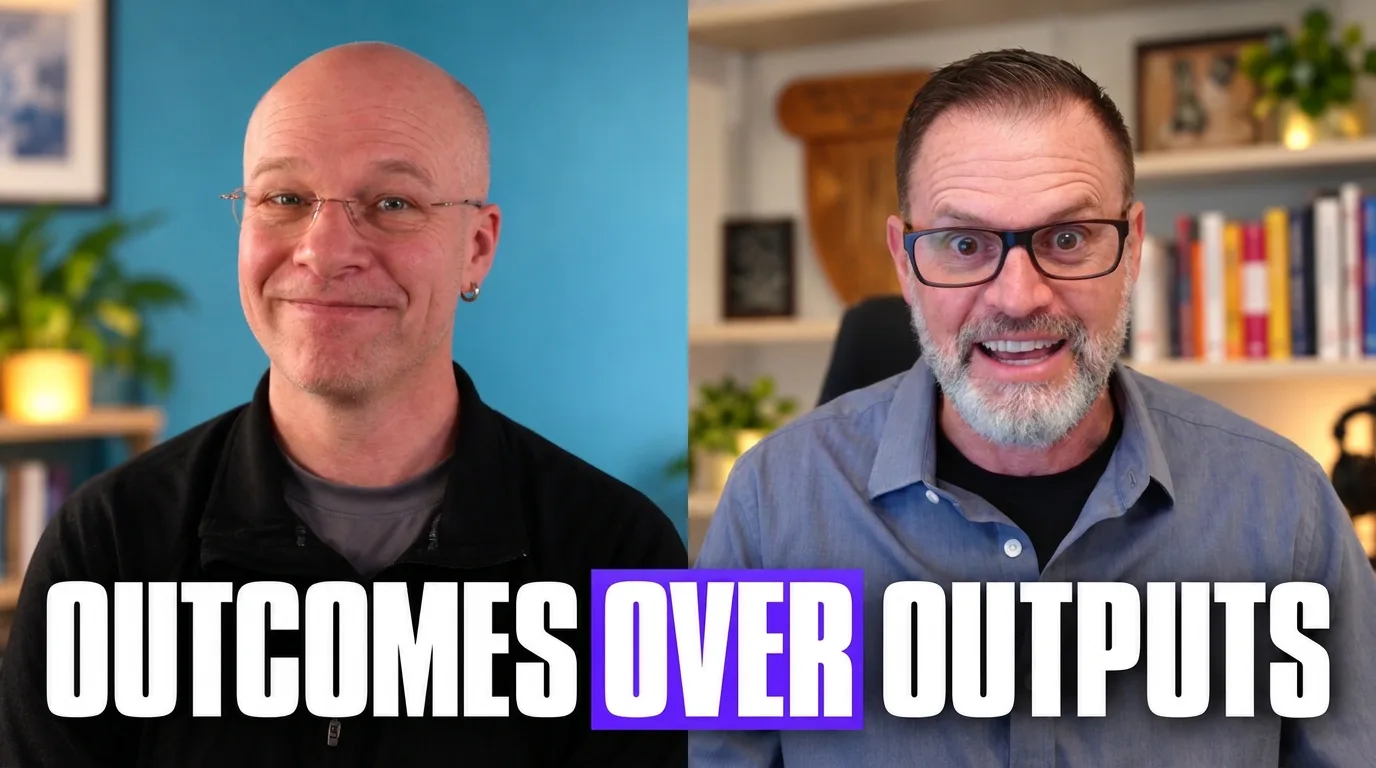
Cohost Lee Rodrigues dropped Final Cut Pro and his loyalty to a workflow that used to work. Sam goes one step further: loyalty belongs to the result, not any tool, old or new, and a tool's say-so isn't evidence.
Host Sam Rogers · cohost Lee Rodrigues · 26 min
A choice this episode can help with
Which tool are you loyal to, and what evidence says it makes the result better?
Run it on your own work: Two Decisions and an Owner, one page, any model.
Watch it below, or read the conversation.
Listen
Or follow the show on Apple Podcasts, Spotify, or in any podcast app.
The signals
- Lee: When the landscape changes, the workflow changes. "You don't build a house with a tool. You build a house with a blueprint." Lee's building short performance-support videos for job seekers and job pivoters, about 35 seconds a concept, and Final Cut Pro, the tool he taught at the Apple Store, isn't the right one for it anymore. Descript's text-based editing finds a clip by its words, and review and rendering happen in the cloud while he works. The tools we used before, "despite your comfort with that tool, might not be the most efficient way."
- Sam: Every platform changes under us; the ones we own don't. The show's very first livestream failed while the encoder said everything was fine. Substack's livestream stops connecting, a new YouTube account waits 30 days to stream, Apple's sign-in looped for two days, and LinkedIn Live took three tries to start [Episode 3](/episodes/ep-003/). "None of those were disasters, but every one of them was a dependency on a tool that I didn't own." The show's site held, so now it publishes first and the platforms link to it downstream. Sam's write-up: https://sam-rogers.com/the-shows-the-thing
The subtractions
- Lee: Final Cut Pro, and loyalty to a workflow that used to work. "I dropped Final Cut Pro and my loyalty to a workflow that used to work." His template-heavy cut took 30 hours; his partner Christine called it "a little AI-ish," and a simpler Descript version took about four, and both "achieved the same objective." His bonus subtraction: stop sending work out for review, which gets you "Looks good," and ask people to test and approve it against stated criteria instead. On the sunk cost: "I'd rather keep learning than defend a habit."
- Sam: Loyalty to the surface. Tools and platforms are surfaces, where the copies land; the result is the artifact. Lee drops loyalty to the old tool; Sam drops it for "any tool, old or new. Loyalty belongs to that result. It does not belong to any tool." Every tool earns its seat with evidence: does it do this well, here, now, measured with the audience in mind, "or is it just faster? Is it just shinier". And "the tool's opinion of itself is not evidence." Asking Claude about a result isn't the same as running the test yourself.
About this episode
The thread through the episode is where loyalty belongs. Lee's case runs tool by tool: the landscape changed, so the workflow did, so Final Cut went. Sam's runs one layer up: as long as the result lives somewhere we own, any tool, old or new, can be swapped out, and each one has to earn its seat.
Midway through, Sam put the question the two of them have argued about for a decade: best for what? "I don't know of anybody who's like shooting IMAX podcasts." Lee's answer is the minimum effective dose: water boils at a set temperature, and more heat just turns more of it into steam. His habit, from their time together at YouTube, is to export a test to its real destination before building anything. Sam's measure is the audience: if they "can't tell the difference between A and B, then arguably there is no difference between A and B." He tied it back to Episode 9, where Lee said the most powerful tool he has is real data, not assumptions.
Lee's switch came from counting. He logs the hours each process takes, and asks AI to tear the plan apart rather than approve it. Claude pointed out he wasn't counting ingestion, about thirty-five minutes per hour-long webinar in Final Cut, and with it counted the job came to six or seven hours in one editor against about three in the other.
One thing to do this week: pick one tool you're keeping, old or new. Write down the result it's for, then the evidence that it makes that result better. Cross out anything that came from the name of that tool. If there's nothing left on the page, it isn't a tool decision yet.
Links from the episode:
- System2Focus: Lee and Christine's site, the one place Lee asked listeners to go
- Two Decisions and an Owner: the episode's takeaway, six questions for one AI-assisted decision
- The show's the thing: Sam's write-up of the platform failures
- Earlier episodes called back: Episode 3 with Christine Rodrigues, Episode 9 with Lee on real data, and Episode 14 with Limited Edition Jonathan on his video process
Want to bring your own signal and subtraction? Find yours.
Transcript
Read the conversation
Lee Rodrigues: It does not matter how much time and money you've sunk into this. What are we doing now? I'd rather keep learning than defend a habit, or defend an old workflow that I used to use. And
Sam Rogers: It's a great way to put it. Welcome to Signals and Subtractions. I'm your host, Sam Rogers. Loyal to the result, not to the tool. That's where we're headed today. Every one of us has some kind of tool that we keep because it's the one that we know, right? The one that we go to. And most of us also have some cool AI tool that we picked up because it was new and cool, and then we just kept using it because we'd already moved things into it. Both of those are loyalty. Neither one is about the result. So I've brought back someone who's been at this table since the very first episode, and we love to talk tools. Lee Rodrigues, welcome back.
Lee Rodrigues: So glad to be back, Sam. I I feel like we talk about the tools people actually use here and I end up leaving every one of these doing like four or five Google searches and downloading something and joining something else and being better for it afterwards. So excited to be here again.
Put it to work
Name one tool your team kept or adopted this year. What evidence, other than the tool's own say-so, says it fits?
The newsletter
Issue 73 · Sunday 18 October 2026 · sent on Substack and LinkedIn.
One signal, one subtraction, one analogy, in five minutes. It draws on this episode but stands on its own. Every issue.
The method from this episode is one page with its copy-paste prompt and schema: Two Decisions and an Owner, linked under the decision above. Every takeaway.
Keep the next choice in view
One signal, one subtraction and one analogy every Sunday. Five minutes, no video required.
Optional. Free on Substack, no account needed. Already on LinkedIn? Subscribe there.