Episode 11 · 2026-09-11
Before Signing That SaaS Renewal
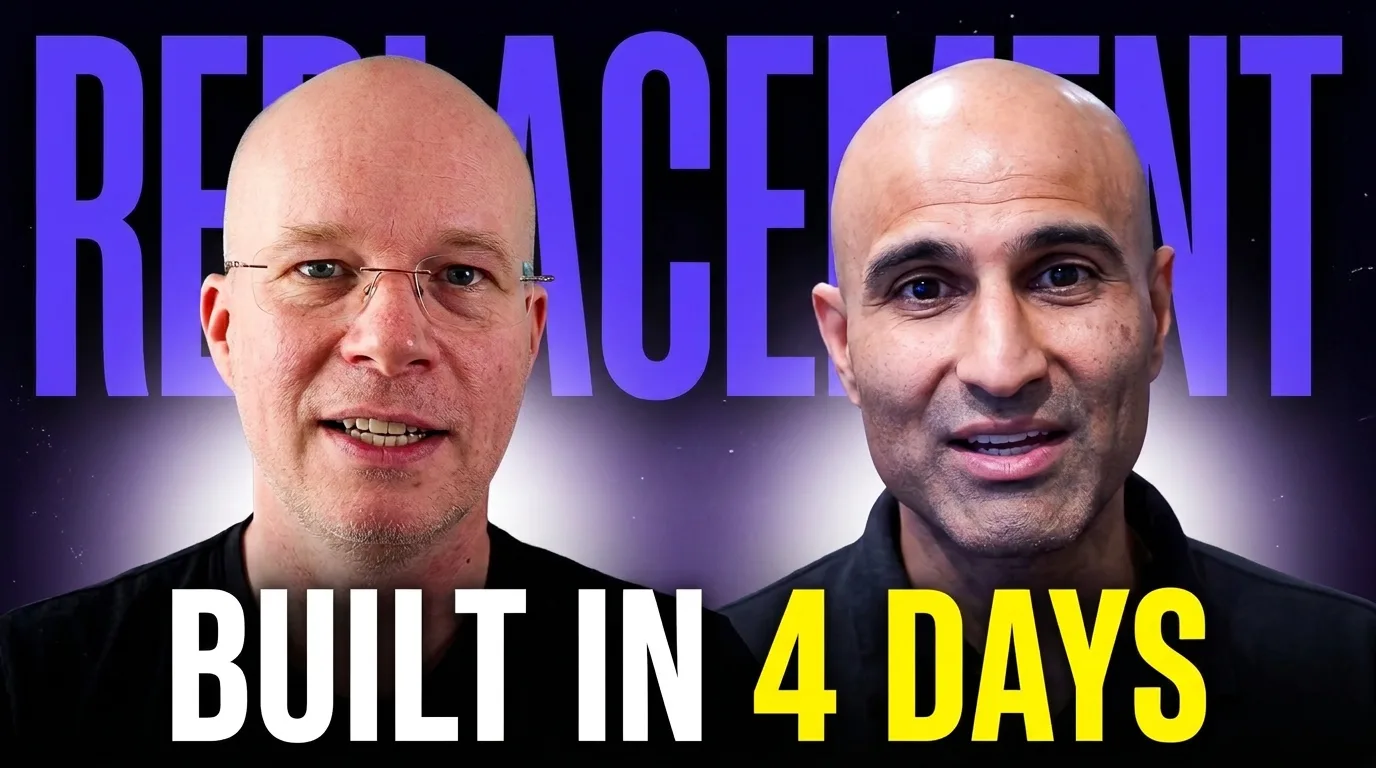
He refused to sign the renewal, asked AI what open source could do instead, and had the replacement running in four days.
Guest Ankit Patel, who runs a company of about sixty people, refused to re-sign HubSpot, asked AI what open source could do instead, and had the replacement running on his own AWS in days.
Host Sam Rogers · guest Ankit Patel, the SMB owner · 30 min
A choice this episode can help with
When the renewal comes up, do you re-sign, renegotiate, or build the replacement yourself?
Run it on your own work: Empty Isn't an Argument, one page, any model.
Run it on your own work: The Renewal Card, one page, any model.
Watch it below, or read the conversation.
Listen
Or follow the show on Apple Podcasts, Spotify, or in any podcast app.
The signals
- Ankit: Clients are buying back 30 percent of the service and doing the rest themselves. His clients started telling him they love the package, but they can get about 30 percent of it now from software they already pay for, and their own team can absorb the other 70. The consequence is not a lost account, it is a repriced one, which meant cutting overhead, which is what sent him looking at his own subscriptions. "It definitely caught my pocketbook".
- Sam: A green run is not proof of useful verification. Six repositories with scheduled research jobs that check each other's work. On the Friday of Labor Day weekend one output was visibly wrong. The failure mode was not a crash: certain research failures came back empty, and as long as one leg of the cascade returned anything the run reported success. "And empty isn't an argument." Ankit had hit the same thing months earlier: "It returned nothing. And that counts because it did something."
The subtractions
- Ankit: HubSpot, and then the habit of buying. The trigger was refusing a year-long contract for a tool they were using a fraction of. He asked AI what open-sourcing the platform would look like, vetted five candidates, and pointed it at his own AWS: Twenty CRM and Chatwoot, company SSO on the front. Built in days, fully transitioned in two weeks against a planned month, and the help desk got faster. His own caveat is the load-bearing one: the speed came from building blocks that already existed.
- Sam: The decision system that made decisions without him. Nine months of building a decision layer into his own second brain, where pre-made decisions sat as lit fuses: unless he acted, the default fired. Then a family emergency took him away for a week and the cascade fired on decisions he had pre-approved under circumstances that no longer held. There was no safety mechanism, because he had not built one. He spent the day before the show defusing every fuse. Ankit's response named it: top-down is not trust, it is authority.
About this episode
The two subtractions run in opposite directions and that is what makes the episode. Ankit removed a vendor and it worked, because the substrate underneath was already his. Sam removed his own automation, because he had built it past the point where he could see whether it was working. Both are the same instruction: look at what is actually running, not at what is supposed to be.
The other thread worth keeping from the tape is where Ankit puts the line between code and models. His first question about any task is whether it is deterministic, or can be mapped until it is; if it can, it is code, every time. AI writes the program, it does not run the business. The worked example is vision insurance, where a prescription crossed with plan tiers produces hundreds of thousands of possible combinations and used to cost twenty minutes of a person's arithmetic per patient. AI learns each new plan and writes the mapping script; the pricing itself is deterministic code. Five to ten minutes saved per transaction, and more to the point, mistakes prevented, which is the kind of thing that kills a small business. He does not use AI for patient information or clinical decisions.
Also on the tape: he gave everyone AI, took it all away, and rebuilt around learning theory instead, chunking concepts and turning them into steps, which is how a 17-step blog-writing process came to exist. His closing hypothesis is that as models improve, the harnesses improve faster, and the scarce skill becomes understanding the concepts well enough to break them down, because the average answer is free now and the value is in the niches around it. Lean, he points out, is not really about removing waste. It is about creating value.
Want to bring your own signal and subtraction? Find yours.
Transcript
Read the conversation
Ankit: It definitely caught my pocketbook, right? Very much like affected us. It's very real. We had to deliver something that was more market capable. We had to reduce our pricing by thirty percent just to be competitive. What are we what are we gonna do to do that? We gotta cut overhead. Hey, I have this HubSpot subscription we pay around eighteen, nineteen hundred bucks a month. Not a huge amount for most people, but enough for us, whereas like made us think of like, Okay, well, what are we really getting with this? That signal made me rethink everything that we were doing.
Sam Rogers: Welcome to Signals and Subtractions. I'm your host, Sam Rogers. So when the software renewal comes up, how do you know whether you should re-sign it or renegotiate it or rebuild that replacement yourself?
Sam Rogers: Just a year ago, that third option wasn't really on the table for most serious businesses. But here in Q3 of 2026, it isn't a joke anymore. And the people that are finding that out aren't necessarily the ones with the biggest AI budgets. They're the ones with the invoice and the question. So my guest tonight is Ankit Patel. He's an industrial engineer who married an optometrist and became the operations department. He and his wife run Classic Vision Care in Atlanta.
Put it to work
What is the next renewal on your calendar, and what would have to be true for you not to sign it?
The newsletter
Issue 68 · Sunday 13 September 2026 · sent on Substack and LinkedIn.
One signal, one subtraction, one analogy, in five minutes. It draws on this episode but stands on its own. Every issue.
The method from this episode is one page with its copy-paste prompt and schema: Empty Isn't an Argument and The Renewal Card, linked under the decision above. Every takeaway.
Keep the next choice in view
One signal, one subtraction and one analogy every Sunday. Five minutes, no video required.
Optional. Free on Substack, no account needed. Already on LinkedIn? Subscribe there.