Scaled or Novel
More trucks, or a new playbook?
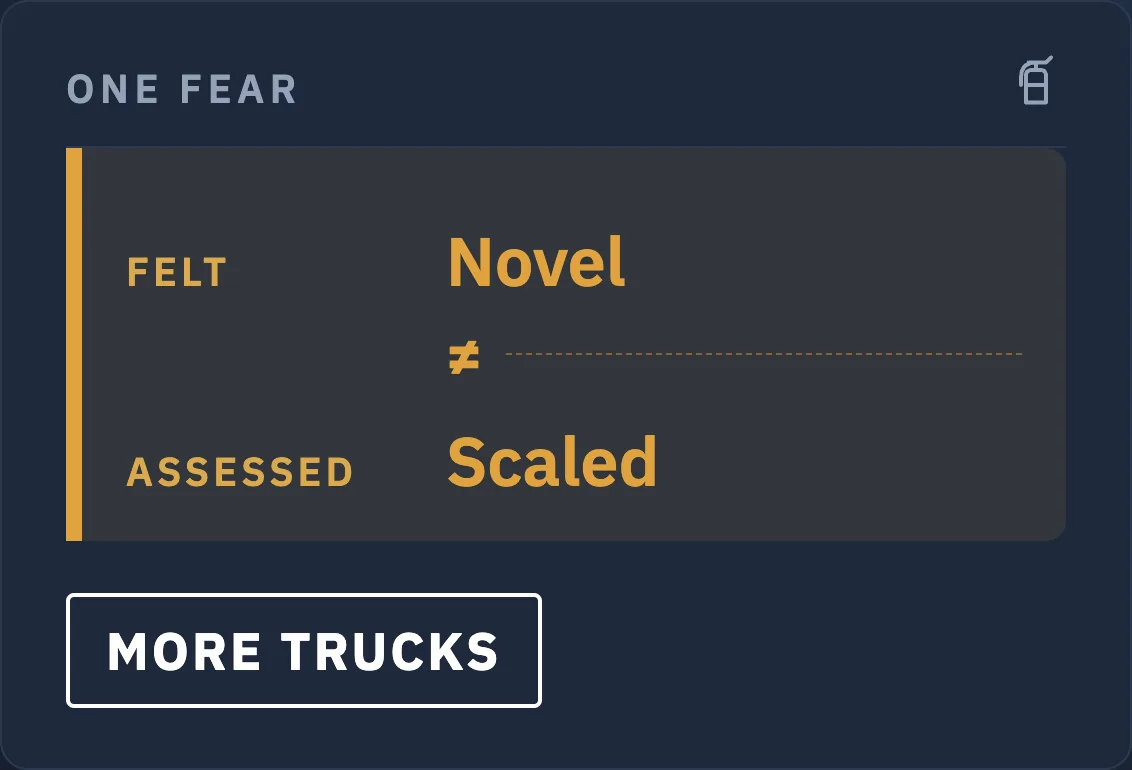
One row per fear we're hearing, placed twice: once as it's felt, once as we assess it.
Which of these fears needs more trucks, and which a new playbook?
For whoever people bring their AI worries to. You bring the AI fears you've heard raised·30min·any model·inventory
It ends in: sorted, unowned, no playbook, not triaged, or not assessed
The decision it forces
Which of the fears we're hearing about AI needs more trucks, and which needs a new playbook?
Someone on the team is worried AI will take their job. Someone else thinks the vendor is training on our data. A third has read that agents will run the company by spring. Each of them is telling the truth about how they feel. The decision is what we do next about each one, and that depends on what kind of problem it actually is.
The SNAP Panic Scale, published at snapsynapse.com on 4 December 2025, sorts a threat into five levels, and its point is the jump between the third and the fourth. Scaled is an old problem at a new size: the fire department needs more trucks. Novel is a fire that doesn't respond to water, and the old playbook won't help. This page places every fear twice, once as the person raising it feels it and once as we assess it, and reads the gap.
To run it, copy the prompt below into any model you already use.
Feelings are facts, and they aren't plans
It's a fact that people have feelings, and that fact deserves respect on its own terms. Nobody worried about their job should be argued out of the worry, rushed past it, or told it's silly. That part of the conversation is about the person, and it doesn't wait for an assessment.
What we do next is a different question. For deciding next actions, a feeling is one more source of information, and it goes through the same judgment as any other. A fear felt as Acute might be Scaled. A fear mentioned in passing, almost as a joke, might be Novel, and that's the row to read first.
So the page keeps the two apart on purpose. The person raising the fear supplies how it feels, in their words. We supply the level we assess and the fact it rests on. The gap between them isn't a correction to deliver. It's what to talk about.
We start with other people because their behaviour is easier to see clearly than our own. There's a variant for ourselves at the end.
The fields
One row per fear, from one group: a team, a function, a client.
| Field | What it holds | Who fills it |
|---|---|---|
group |
The team, function or client the fears came from | you |
fear |
The concern as it was raised, in their words | you |
raised_by |
A role, never a name | you |
felt_level |
1 to 5, as the person raising it would place it. Ask them if you can | you |
felt_level_source |
Whether they placed it themselves or we're estimating | you |
assessed_level |
1 to 5, our read | either |
basis |
The fact our read rests on: a precedent, the playbook that already covers it, or evidence that it's happening | either |
assessed_by |
Ours, or a model's draft we accepted | either |
next_action |
What the assessed level asks of us, from the table below | derived |
spotter |
Level 2: who watches for it | you |
owner |
Level 3: who owns the existing playbook. Level 4: who owns writing the new one | you |
due |
Level 4: when the new playbook is delivered | you |
priority |
Level 5: where it sits in triage | you |
heard |
Whether the person was told their concern was heard, whatever its level. Recommended, and a judgment call | you |
gap |
felt_level minus assessed_level |
derived |
verdict |
The first rule below that applies | derived |
What each assessed level asks of us:
| Level | Name | What it means | Next action |
|---|---|---|---|
| 1 | Impossible | Not possible on any theory we have | Ignore it |
| 2 | Plausible | Could happen; hasn't, as far as we know | Acknowledge it, and name a scout or spotter |
| 3 | Scaled | An old problem at a new size | Name the owner of the playbook that covers it |
| 4 | Novel | Needs a playbook we don't have | Name who writes it, and the date it's delivered |
| 5 | Acute | It's happening to us now | Prioritize it, and triage |
Level 5 isn't a figure of speech. For a lot of people and organisations it describes the next eighteen months, and a row at 5 gets the same seriousness as an incident.
There's no worked example on this page: a filled list is real people's fears, and they belong to the people who raised them.
The verdict rule
- 1st Not assessed Any row with an assessed level and no basis Write down the fact the read rests on, or take the level off
- 2nd Not triaged Any row assessed at 5 with no priority Triage it before anything else on the list
- 3rd No playbook Any row assessed at 4 without an owner and a due date Name who writes the new playbook, and when
- 4th Unowned Any row at 3 with no owner, or at 2 with no spotter Name the owner or the spotter
- 5th Sorted Every row has its level's next action Keep the list, and read it again when the fears change
Take the first rule that applies. A level without a basis is a second feeling, not an assessment, which is why that rule comes first. Then the rules run from the most acute level down, because the list is only as sorted as its worst row.
The gap is reported beside the verdict, counted three ways: felt_higher, felt_lower and matched. Felt higher is the usual case, and the conversation it asks for is about the basis, not the feeling. Felt lower is the one to read first: a Novel threat someone is treating as Scaled is a fire we're about to fight with water.
Run it with any model
The model interviews, one fear at a time. It may draft an assessed level, marked as its draft and with its basis stated. It never sets the felt level, never names anyone, and never decides how someone feels.
The rows are other people's worries. If the chat is saved, consider a temporary one.
Help me sort the AI fears people around me are raising, with a Scaled or Novel
list. It uses the five levels of the SNAP Panic Scale: 1 Impossible (not
possible on any theory we have), 2 Plausible (could happen, hasn't as far as we
know), 3 Scaled (an old problem at a new size), 4 Novel (needs a playbook we
don't have), 5 Acute (it's happening to us now). The jump from 3 to 4 is the one
that matters.

Interview me one fear at a time, and wait for my answer each time.

1. fear: the concern as it was raised, in the words of the person who raised it.
2. raised_by: their role. If I give you a name, tell me the list holds roles
   only, and record the role.
3. felt_level: how the person raising it would place it, 1 to 5. Ask whether
   they placed it themselves or I'm estimating, and record which.
4. assessed_level and basis: ask me for my read and the fact it rests on. If I
   ask, you may draft a level and its basis, marked as your draft, for me to
   accept or change.
5. The next action the assessed level asks for. At 2, ask who watches for it. At
   3, ask who owns the playbook that already covers it. At 4, ask who writes the
   new playbook and by what date. At 5, ask where it sits in triage.
6. heard: whether the person has been told their concern was heard. This is a
   courtesy I'm recommending to myself, not a test.

Then ask whether there's another fear, until I say there isn't.

RULES YOU DO NOT BREAK
1. Never set or change felt_level. It's the person's, reported by me.
2. Never name a person, suggest one, or infer one from a role.
3. Never describe anyone's feelings as wrong, irrational or overblown. A gap
   between felt and assessed is something to talk about, not a correction.
4. Never assess a level without a basis. With no basis, leave assessed_level
   null.
5. Never fill spotter, owner, due or priority.

OUTPUT
Valid JSON matching the schema scaled-or-novel/v0.1 as published at
https://sigsub.show/takeaways/scaled-or-novel/, with counts for rows,
felt_higher, felt_lower, matched and heard. Then the same as a table with empty
fields left visibly empty. Then the verdict, using the first rule that applies:
not assessed (a level with no basis), not triaged (a 5 with no priority), no
playbook (a 4 without an owner and a due date), unowned (a 3 with no owner or a
2 with no spotter), otherwise sorted. Then one line naming every row where felt
is lower than assessed.
What to check in the answer
The model may hold the five levels, ask the questions in order, and draft an assessed level when asked, as long as each draft carries its basis and says it's a draft.
It may never set a felt level, which is the person's report of their own experience, and it may never put a name in the list. Check that no row's assessment came without a fact behind it, and that nothing in the answer tells us anyone's fear is unreasonable. That isn't the model's call, and it isn't ours to make out loud either.
For our own calibration
The same list works on our own fears, and it isn't built out here. Fill felt_level first, from the gut, before thinking. Then write the basis, and only then the assessed level. The gap is ours to read.
The part that's not optional
Ask the person. Where they'll say how it feels on a scale of one to five, their number goes in, not our guess at it. And tell them the concern was heard before anything is done about it, whatever level it lands on.
For builders
The answer format
{
  "schema": "scaled-or-novel/v0.1",
  "group": "the team, function or client these fears came from",
  "fears": [
    {
      "fear": "the concern in their words",
      "raised_by": "a role, never a name",
      "felt_level": null,
      "felt_level_source": "placed by them | estimated by me",
      "assessed_level": null,
      "basis": null,
      "assessed_by": "me | model draft accepted",
      "next_action": "ignore | spotter | owner | new playbook | triage",
      "spotter": null,
      "owner": null,
      "due": null,
      "priority": null,
      "heard": null,
      "gap": null
    }
  ],
  "counts": {
    "rows": 0,
    "felt_higher": 0,
    "felt_lower": 0,
    "matched": 0,
    "heard": 0
  },
  "verdict": "not assessed | not triaged | no playbook | unowned | sorted"
}
Got an answer back from the prompt? Read it against this schema. It runs in your browser and sends nothing.
Report back
Ran this? Tell us what happened. What broke and what you changed are the useful parts, because that's how the next version gets better.
Or write to hey@sigsub.show with Takeaway: scaled-or-novel as the subject. It's a plain email: no form, no account, nothing tracked. Nothing you send appears here unless you say yes, and you choose how you're named.
Keep the next choice in view
One signal, one subtraction and one analogy every Sunday. Five minutes, no video required.
Optional. Free on Substack, no account needed. Already on LinkedIn? Subscribe there.